In Northern California, a Vietnamese-American family has spent six years turning an empty 2,000-square-meter plot behind their house into a working slice of the Mekong Delta — fruit trees, herb beds, hammocks, a koi pond and all. Their story, shared in a video that has pulled in nearly three million views, is part gardening project, part cultural preservation effort.
Ngoc Loan, 37, left southwestern Vietnam for the United States in 2013 and brought her mother, Nguyen Ngoc, over in 2019. Noticing how much her mother missed rural routines and kitchen gardening, Loan and her husband decided to transform the vacant land behind their home. They also wanted their two American-born children to grow up knowing the food and domestic traditions of their mother's home region.
The project started in 2020. After hiring a crew to clear thick weeds, the couple tilled the soil, raised garden beds, composted, and planted seedlings by hand. The hardest part was sourcing the right plants. Common fruit trees came through Vietnamese diaspora networks across the US, but delicate herbs — sawtooth coriander, cilantro, Thai basil — meant a three-hour drive to Vietnamese grocery stores to buy fresh sprigs and root them in water at home. Dozens of cuttings died before any took hold; they simply started over.
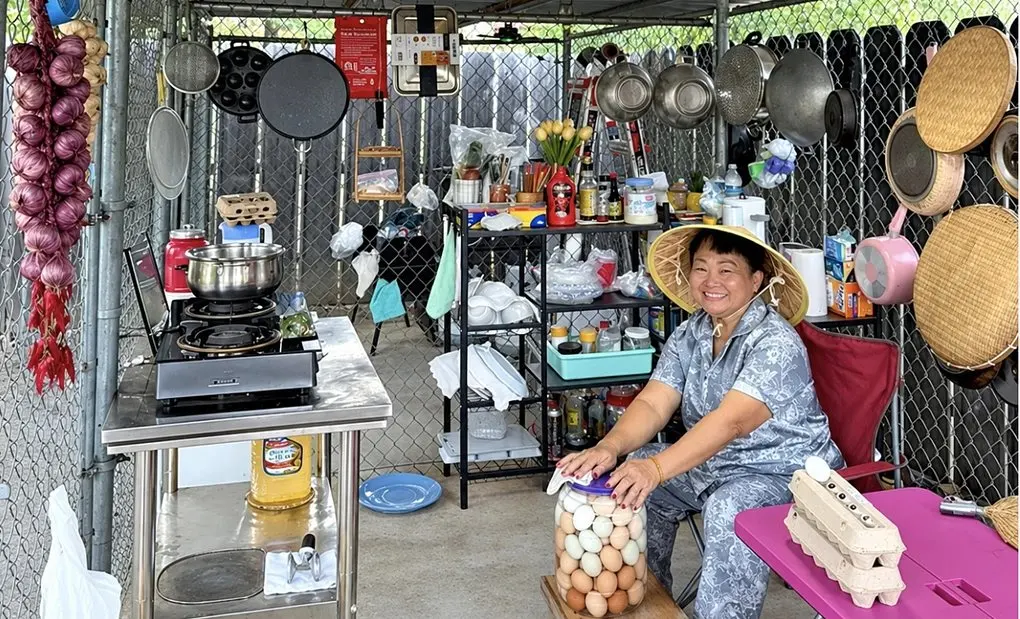
Six years on, the plot carries dozens of fruiting varieties: coconuts, peaches, limes, plums, jujubes and bananas, plus seasonal beds of water spinach, luffa, okra, bitter melon, chili and more. In early 2025 they finished the centrepiece: an open-air kitchen pavilion with corrugated metal roofing and a steel mesh frame. Local contractors handled only the beams, roof and concrete slab — the wiring, masonry wash basins, shelving and tiling the couple did themselves. Behind it, coconut palms and a koi pond designed to echo village canals complete the picture.
The cookware is authentic too: bánh xèo crepe pans, cast-iron molds for bánh khọt, and woven bamboo trays brought straight from Vietnam. The pavilion now anchors family life — weekend harvests, outdoor meals in hammocks, and southern specialties like bún mắm (fermented fish noodle soup), braised eggplant soup and grilled squid for the grandchildren. Loan often cooks extra for American neighbours, who keep asking about the breezy pavilion design.
Why does this matter to travellers? It's a reminder that some of the most vivid Vietnamese food culture outside Vietnam lives in diaspora backyards, and that heritage travel isn't only about flying somewhere — sometimes it's about who lives next door. For anyone visiting California's Vietnamese-American communities, from San Jose to Sacramento's Little Saigon, this story captures the flavour of what you'll find in the markets, restaurants and family kitchens there: recipes carried across the Pacific and stubbornly kept alive.
And for anyone who has ever tried to grow Thai basil in a foreign climate, Loan's perseverance will ring familiar. 'Sitting here listening to cicadas and singing birds in the yard makes me feel as if I am back in my home village,' her mother says. That's the whole point, in one sentence.