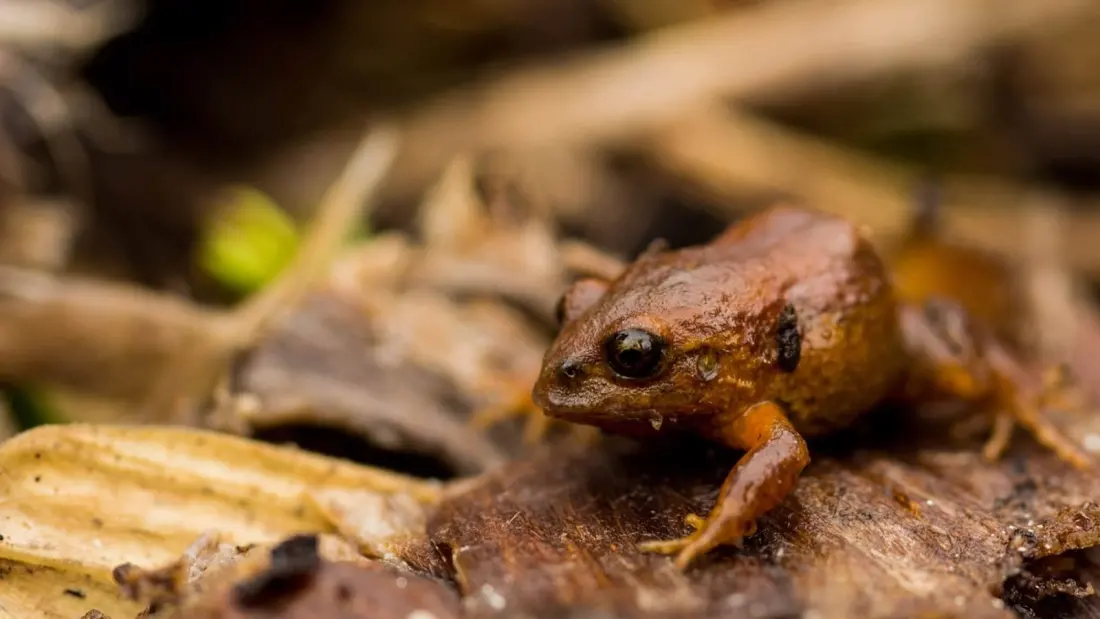
Colombia has a new amphibian on its books: Niceforonia florezarum, a frog small enough to sit on a fingertip, found only in the high-altitude paramos of Purace National Natural Park in the country's southwest. The national parks authority announced the find on November 17, 2026, after a study published in Zootaxa described the species formally in September.
This was no quick discovery. Researchers made 15 sampling trips between 2017 and 2023, combining body measurements, genetics, ecological notes and bioacoustics — the analysis of the frogs' calls — to prove the animals were distinct from every known relative in the genus. The result: Colombia now hosts more than 10 known Niceforonia species, six of them paramo specialists.
The frog itself is modest-looking, with reddish-brown skin, small back bumps and cream-spotted belly. Notably, it lacks the widened toe pads of its cousins, hinting at a life spent on the ground under logs, leaf litter and moss near frailejones, the furry-leaved plants that define these high Andean grasslands. It has so far been recorded at only two sites — Laguna Sanchez inside the park and the Guanacas paramo between Totoro and Inza — at a narrow altitude band of roughly 3,340 to 3,583 metres.
One observation stood out: an adult female found guarding 19 eggs buried about five centimetres underground. If confirmed, it would be the first evidence of parental care in the genus, though researchers stress a single sighting proves little yet. Its closest known relative lives about 195 kilometres away in Narino and northern Ecuador — a neat illustration of how each Andean mountaintop acts like an island, with isolated frog populations slowly becoming separate species.
For travellers, the real story is Purace itself. The park covers 92,148 hectares and climbs from 2,350 to 4,700 metres, protecting Andean forests, high-Andean woodland and paramo in one sweep — a landscape where endemic species are still being found. Scientists can't yet assess the new frog's conservation status, and with just two known localities, its fate hangs on the health of these wetlands. The park is already known for its volcanoes, hot springs and Andean condor sightings, so this find adds another reason to explore a corner of Colombia most visitors skip.