A few blocks from Wall Street, tucked between the financial district and the southern tip of Manhattan, there's a small memorial most office workers hurry past without a second glance. The Queen Elizabeth II September 11th Garden honors the British and Commonwealth citizens who died in the 2001 World Trade Center attacks, and it hides one of the more unusual memorial objects in New York City: a hefty rock hauled across the Atlantic from Scotland.
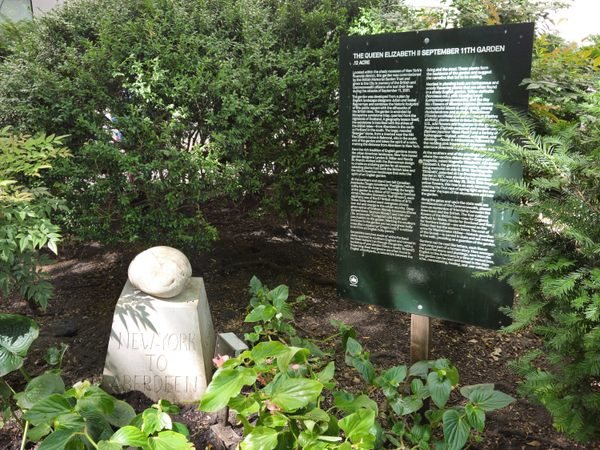
That stone is known as the Braemar Stone, and it comes with a backstory. Braemar stones are a fixture of ancient Celtic strength games — rounded rocks weighing anywhere from 19 to 28 pounds (about 8.6 to 12.7 kg), thrown much like a modern shot put. The one in this Manhattan garden only looks like a competition stone. It was never tossed at any Highland Games. Instead, it was lifted from the River Dee near Balmoral, the British royal family's private residence in Scotland, and shipped to New York specifically for this memorial.
The stone now rests on a small plinth inscribed "New York to Aberdeen," with the distance between the two places marked underneath — though the ground has partially covered that detail over time. The inscription is the point: it's a nod to the royal family's personal connection to the memorial, linking a Scottish riverbank to a patch of Lower Manhattan. And that's just one layer of symbolism in a park designed to carry a lot of quiet meaning for anyone who slows down long enough to notice.
Practically speaking, the garden is easy to fit into any downtown itinerary. It sits midway between Wall Street and the waterfront, close enough to the World Trade Center site to form a natural stop on a Lower Manhattan walk that might also take in the 9/11 Memorial & Museum or St. Paul's Chapel. The park is open around the clock, so there's no ticket, no queue, and no time pressure. The stone itself is on the west side of the garden, right beside a large sign explaining the park's history and design — worth a read, since much of the memorial's symbolism isn't obvious at first look.
For travellers interested in history, architecture, or the quieter corners of New York, this is the kind of detour that rewards curiosity. It's also a reminder that the events of September 11 reverberated far beyond the city itself: 67 British citizens were among the victims, along with others from across the Commonwealth, and this garden exists because their home countries wanted a place for them near where they died.
If you're already in the financial district grabbing lunch or waiting for the Staten Island Ferry, budget ten minutes here. Look for the plinth, read the sign, and you'll come away knowing a story that most people standing on the same patch of pavement will never hear.