
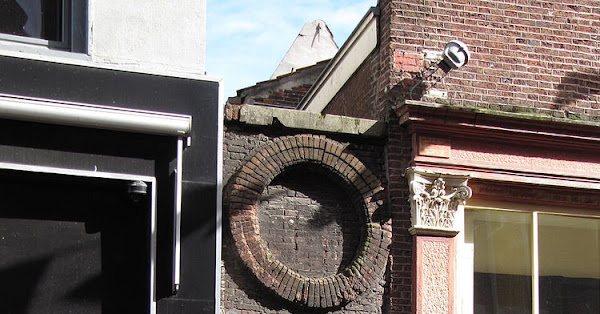
Most countries protect palaces, churches or entire historic districts. The Netherlands, famously thorough, has listed a doorway. At Smedestraat 33, in the shopping heart of Haarlem's old centre, a 17th-century brick gateway with a wooden door carries national monument status — and the protected object is the gateway alone, not the buildings around it.
The listing, recorded as Rijksmonument No. 19695 in the official register, hinges on craftsmanship rather than grandeur. The gateway dates from the second half of the 17th century and features finely worked brickwork, crowned by a blind circular window — a decorative round opening punched into the masonry above the arch, with no actual view through it. That oculus is the detail that convinced heritage officials this fragment deserved permanent protection.
The door's original job explains why it matters to anyone interested in how Dutch cities grew. It once served as an open passage between two houses, leading down an alley to the Wijngaardtuin, a small garden tucked behind the street frontage. In historic Dutch cities, alleys like this were the plumbing of the urban block — giving access to rear properties and to dwellings on upper floors. When ground floors along shopping streets were progressively converted into shops, most of these passages vanished. Smedestraat 33 survived, which makes it a rare physical trace of Haarlem's older street layout.
There's a modern wrinkle too. The municipality now sees these locked, inaccessible doorways as potential fire hazards, and in recent years officials have been working to 'unlock' such spaces and convert them into usable rental housing, including student accommodation. So the monument may yet get a new working life rather than simply standing as a curiosity.
For travellers, this is exactly the kind of detail that rewards wandering Haarlem on foot. The city, just fifteen minutes by train from Amsterdam, is often treated as a day-trip afterthought — but its historic centre is dense with medieval and Golden Age fabric, from the Grote Kerk to hidden courtyards and hofjes. Knowing that an unassuming door on a busy shopping street is a listed national monument changes how you read the street: those odd gaps between shopfronts aren't random, they're the residue of a centuries-old system of alleys and rear gardens. Spotting the blind oculus above the arch takes seconds and costs nothing. It's a nice reminder that in the Netherlands, heritage isn't only the big set pieces — sometimes it's a single well-laid brick arch hiding in plain sight.