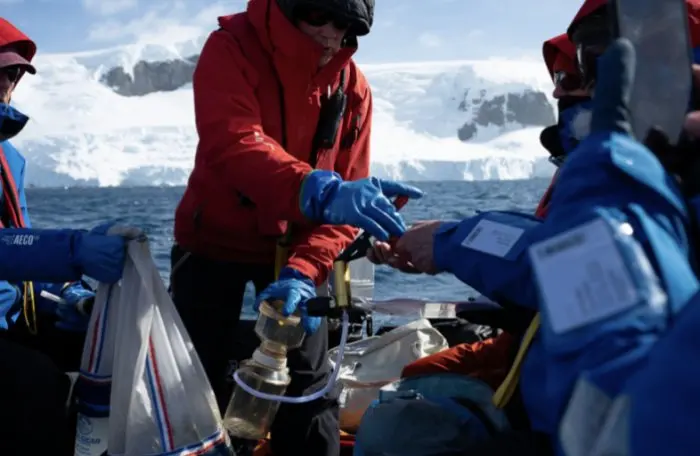
Antarctica cruises are usually about ice and wildlife. AE Expeditions' 2026-27 season adds a third element: real, ongoing science happening on deck while you watch. The Australian-owned expedition line has released 27 voyages across three small ships — the Greg Mortimer, Sylvia Earle and Douglas Mawson — and on 11 of them, 18 researchers will sail as working passengers.
The research spans five projects. A team from the University of California, Santa Cruz, led by Professor Ari Friedlaender (30 Antarctic seasons under his belt) and including WWF's Chris Johnson, will study whale behaviour and health using drones and minimally invasive sampling. Six scientists from Oceanites will continue the long-running Antarctic Site Inventory, counting penguins and tracking breeding colonies on the Peninsula by foot and drone. Others from the University of Tasmania's IMAS will monitor disease and environmental stress in whales, seals and seabirds, while Reef Life Survey divers add Antarctic data to a global underwater biodiversity dataset.
The headline grabber is Project ESCA. On the 32-day Epic Antarctica voyage from Dunedin to Ushuaia (7 January to 7 February 2027), scientists from the Museum of New Zealand Te Papa Tongarewa and Auckland University of Technology will deploy a specially built deep-sea camera system to try to film the colossal squid in the wild — a creature so elusive it has barely ever been observed alive in its habitat.
Itineraries run from nine to 34 days and cover the Antarctic Peninsula, the Antarctic Circle, Weddell Sea, South Georgia, the Falklands, Ross Sea and East Antarctica, with a cap of 130 guests per departure. Standout options include the Ross Sea Odyssey from Hobart to Dunedin (14 December 2026 to 8 January 2027), which visits explorer-era huts and subantarctic penguin colonies; Antarctica Complete over Christmas and New Year, linking the Peninsula with South Georgia and the Falklands; and the nine-day Antarctic Explorer Express, which flies one-way across the Drake Passage so time-poor travellers can skip the roughest stretch of ocean.
For travellers, the science programme changes the texture of the trip. Instead of lectures delivered from a script, you get researchers counting penguin nests in the morning and talking through their data over dinner. If you've already "done" a standard Peninsula cruise, the Ross Sea and East Antarctica routes offer a far rarer, more historic slice of the continent — and the chance, however slim, of being on board when a colossal squid appears on camera for the first time.