
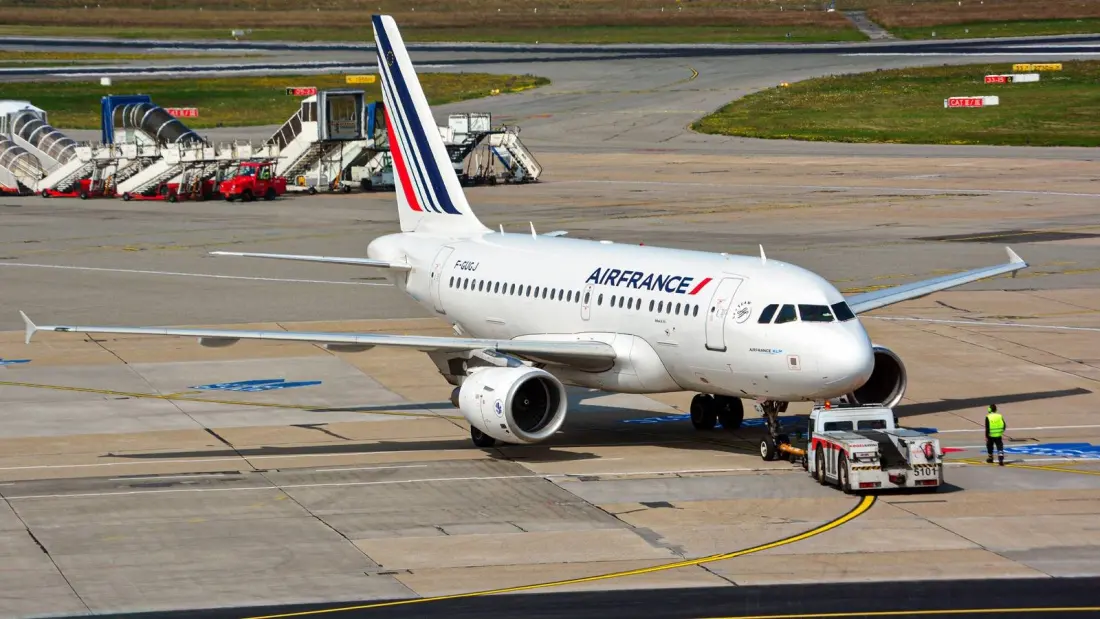
Only four Airbus A318s still fly scheduled passengers, all with Air France from Paris Charles de Gaulle. The aircraft's biggest party trick — a certified 5.5-degree steep approach into London City Airport, roughly double the normal three-degree glide — was engineered brilliantly and sold badly. Now, with Air France's schedule filings extending A318 operations only into March 2027, the type's commercial story is nearly over.
The A318, nicknamed the 'Baby Bus', was a shortened A319 built for the 100-to-120-seat market. It entered service in 2003 and sold just 80 units, a rounding error next to the thousands of A319s, A320s and A321s Airbus shifted. Its defining feature arrived via software rather than hardware: modified flight-control laws command extra deployment of the existing spoiler panels, generating enough drag to hold a steep descent into obstacle-constrained airports. EASA certified the system in 2006 for London City, where below 120 feet the spoilers deploy automatically during landing.
British Airways made the capability famous with an all-business-class London City to New York service, a route only the A318 could really serve. But clever niche engineering doesn't scale. Few airports worldwide combine the runway, terrain and noise constraints that make a steep approach necessary, and airlines flying ordinary networks could always earn more with an A319's extra seats on the same routes. Some A318s drifted into corporate and government roles; TAROM, which flew the type since the mid-2000s, ran its final commercial A318 flight on 26 October 2024 and offered the aircraft to an end-of-life specialist.
The bigger blow came from Airbus's own A220-300, designed from scratch for exactly this market segment. Air France, which has ordered 60 of them, cites a 20% fuel saving, 10% lower seat costs and a 34% smaller noise footprint versus the A318s and A319s they replace. Against economics like that across an entire network, a handful of specialised jets is impossible to justify — especially when maintenance, crew planning and spares support must all be spread across just four airframes: F-GUGM, F-GUGN, F-GUGO and F-GUGP.
For travellers, there's a genuine ticking-clock element here. Spotting the last A318s in airline service means a short-hop flight from Paris CDG to a European destination before 2027 — likely the final chance to fly the smallest, rarest member of the A320 family. Aviation enthusiasts have chased rarer metal, but not much of it: an airliner that once pitched itself at London City's tricky approaches will bow out quietly, its smartest feature still working perfectly, just no longer needed.