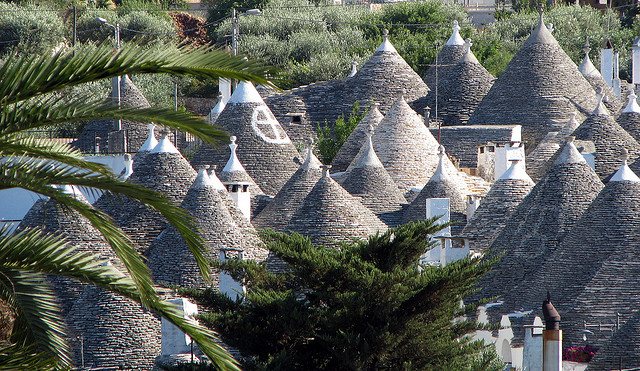
Whitewashed cones stacked in neat rows, Alberobello looks like a set designer's fantasy — and the resemblance to a Mediterranean Hobbiton isn't far off. This small town in southern Italy's Puglia region is built almost entirely of trulli, dry-stone dwellings with conical roofs that have been standing for centuries, some around 600 years.
The engineering is the interesting part. Trulli are assembled by corbelling — masonry layers that jut progressively inward until they can carry a conical roof — a technique dating back to Neolithic times. No mortar, no foundations: the walls sit directly on underlying rock, with limestone slabs hauled in from nearby fields. A double-wall design with rubble packed between the layers insulates against winter cold, and built-in fireplaces and stoves mean little heat goes to waste. Even the rain is put to work — roof eaves channel water into shared cisterns, effectively guaranteeing a summer supply. By modern standards, these are accidental eco-houses.
So why skip the mortar? Two local stories compete. One says settlers were required to build dismantlable homes so the land could be cleared quickly if they were ever dispossessed. The other claims residents dodged a 17th-century building tax, since an un mortared structure arguably wasn't a 'real' house — though many trulli predate that era, which rather undercuts the tale.
The town itself grew slowly. Around 50 trulli stood here in the 1500s; a century later a bakery, inn and mill arrived, all in the same style, turning a village into a town under feudal rule. When the fiefdom ended, King Ferdinand IV of Naples granted it royal town status in 1797, and residents named their previously nameless settlement Alberobello. Curiously, that official recognition coincided with new trulli construction almost stopping entirely — the surviving ones were simply maintained, generation after generation.
Today people still live in these houses, and while tourism has arrived, most visitors are Italian, which keeps the atmosphere more working town than open-air museum. Locals welcome foreign guests too, with a friendly caveat: this is a living community, not a film set.
For travellers, Alberobello is an easy add-on to a Puglia itinerary — an hour or so from Bari, and a good base for exploring the wider Itria Valley, where trulli dot the countryside around Locorotondo, Martina Franca and Cisternino. Go early morning or late evening in summer to see the lanes without the crowds, and consider sleeping in one: many trulli now operate as guesthouses, so you can spend a night under a corbelled roof that has held itself up for half a millennium.