Fondue belongs to the Alps, no question — it's the default après-ski ritual in resorts like Gstaad and Verbier, where a bubbling caquelon of cheese is as much a part of the evening as the last run down the mountain. But according to the chefs and cheesemongers who make it for a living, this is one holiday indulgence that travels home with you surprisingly well.
Francesco de Bartolomeis, executive chef at The Alpina Gstaad — whose wood-panelled Stübli restaurant serves fondue and raclette the traditional way — insists everything starts with the cheese. His recipe for a classic Swiss pot: equal parts Gruyère AOP and Vacherin Fribourgeois AOP. The Gruyère brings depth and complexity; the Vacherin delivers the creaminess that makes the dish what it is. His one hard rule is to avoid pre-grated supermarket cheese, which often contains additives that stop it melting properly.
If you'd rather break from tradition, the team at London's Neal's Yard Dairy suggests a more playful approach. Georgia Hollands there starts with Ogleshield, a washed-rind Somerset cow's milk cheese famous for its melting qualities, sharpens things up with Montgomery's Cheddar, then mixes in Irish options like Gubbeen and Durrus. In other words, a fondue pot is forgiving terrain for experimentation — as long as the base cheese melts reliably.
The mistakes are predictable and avoidable. A good fondue should be smooth and thick enough to coat a piece of bread without turning stringy or clumpy. That means getting the ratio of dry white wine to starch right, heating gently — never letting it boil — and stirring continuously. Rush the heat and the fats split; skimp on the starch or overdo the wine and you end up with a watery pot. Check the consistency before it reaches the table, not after.
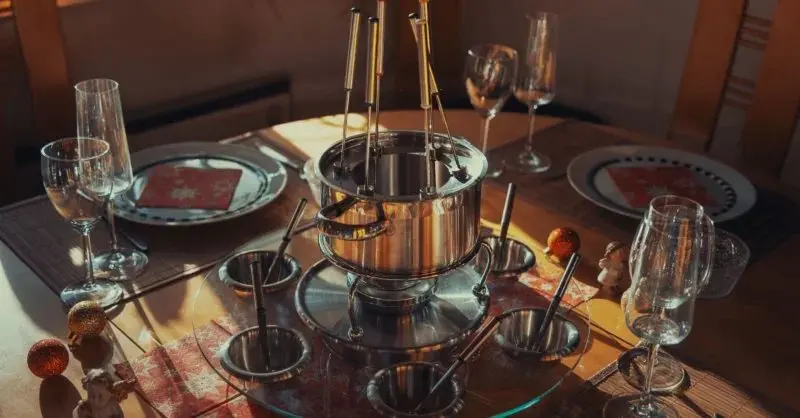
Equipment matters more than you'd think. The classic Swiss caquelon, usually ceramic or enamelled cast iron, is built to spread heat evenly and hold temperature through a long, slow meal. De Bartolomeis has used a Le Creuset set at home for years and rates its heat retention and durability. If you're planning to make fondue a regular winter thing, the advice is to buy a substantial pot with a dependable burner rather than a novelty set that can't hold a steady temperature.
For those who want to go further upmarket, the options get properly luxurious. Mauviel, a seventh-generation family cookware maker in the Normandy town of Villedieu-les-Poêles (literally 'city of pans'), sells a copper fondue set with six forks and a glass lid, prized for its temperature control. Milanese atelier Lorenzi Milano makes a two-litre enamelled cast-iron pot with numbered forks finished in stag antler. Staub does an all cast-iron cherry-red version made in France, and Le Creuset's Signature set covers the colourful, practical end of the range.
Why should a traveller care? Because fondue is one of the few resort rituals you can genuinely recreate — a taste of a Gstaad winter on a Tuesday night, provided you buy real cheese, go easy on the heat, and own a pot that can hold it.