Almaty has quietly built one of Central Asia's most interesting collections of street art, turning apartment-block walls into a public gallery you can walk through for free. Over the past decade, local and international artists have covered facades with snow leopards, eagle hunters, Soviet-era photographs and even a tribute to Gorillaz — and the story of what's happening to these works now says a lot about where the city is headed.
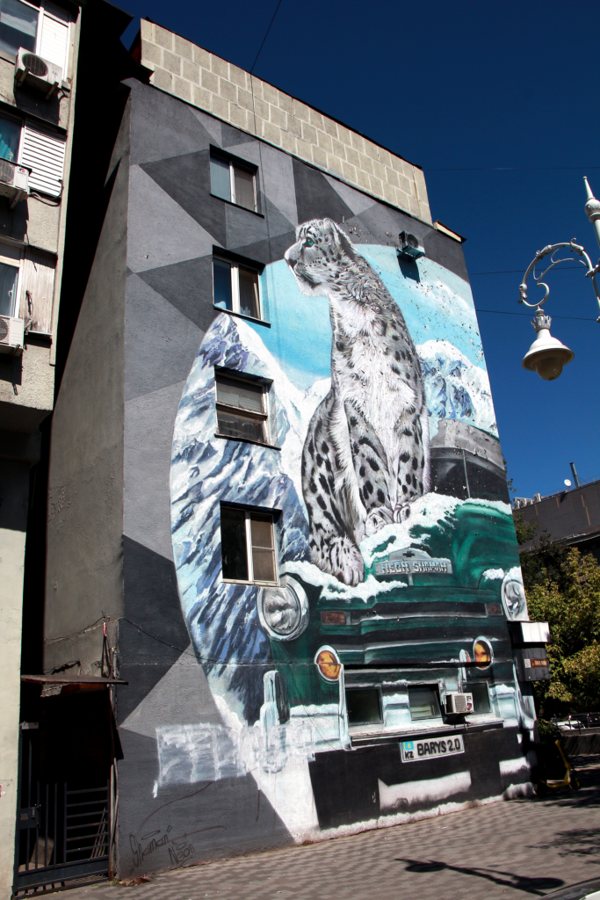
The boom came via international street art festivals held between 2016 and 2019, which brought painters from Kazakhstan, Belarus, Ukraine and the UK to work on residential buildings. The results became landmarks in their own right. Neon & Shaman's "Snow Leopard 2.0" (59 Abylai Khan Avenue, 2017) pairs the region's iconic mountain cat with a snowy peak. Ukrainian artist Andrii Palval painted "Berkutchi" at 111 Rozybakiev Street, honouring the traditional Central Asian eagle hunter. Belarusian artist KONTRA's "Girl with Petroglyphs" wove in imagery from the ancient Tamgaly rock carvings and the local aport apple.
Other works anchor the city's memory. "Father of Apples" by 310 Squad (2013) celebrated Almaty's claim as an ancestral home of the apple; "Waiting" by Saule Suleimenova and Kuanysh Bazaraliyev (565 Seifullin Avenue) recreated a real photograph from late-Soviet Almaty. There are portraits of poet Mukagali Makatayev on the street named after him, and singer Roza Baglanova on a building where she once lived — a project initiated by residents themselves. At the other end of the spectrum, a Gorillaz mural appeared in August 2026 on Navoi Street ahead of the band's Park Live festival set, and one artwork was painted at 3,200 metres up at Shymbulak ski resort for the UN's 80th anniversary.
But the gallery is under pressure. Facade renovation programmes have already covered several murals, including "Girl with Petroglyphs" and "Father of Apples" — though the latter was reportedly physically preserved behind the new cladding rather than destroyed. The Bostandyk District administration says affected buildings had cracks and peeling plaster, residents consented to the work, and artists will be offered new walls elsewhere. Officials are also considering QR-code plaques so passersby can still see images of the lost works. Not every mural is guaranteed survival, though, so it's worth checking conditions before planning a photo route.
For travellers, this is a genuine reason to linger in Almaty rather than pass through en route to the mountains. The murals double as a self-guided tour of the city's identity: its wildlife, its nomadic heritage, its Soviet past and its pop-culture present, all within a compact, walkable grid framed by the Trans-Ili Alatau peaks. Pair a morning of mural-hunting around Abylai Khan Avenue, Tole Bi and Seifullin with an afternoon trip up to Shymbulak, where you can see the highest-altitude piece in the collection and ride the gondola while you're there. Just go soon — some of these walls may not be there forever.