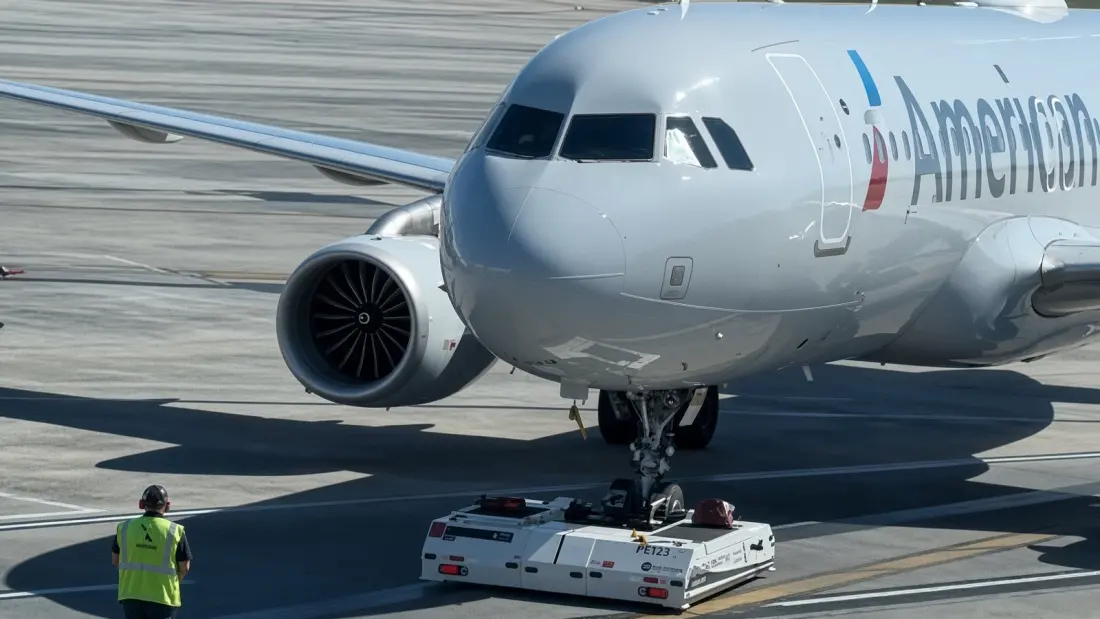
A video of an American Airlines jet being nudged around Charlotte Douglas International Airport by an electric pod under its nose gear has people calling it the 'airport Roomba.' It is actually a Mototok Spacer 8600 NG, a remote-controlled aircraft tug, and while it looks odd, the technology behind it is quietly fixing one of the mundane but real causes of gate delays.
Traditional pushback works with a tractor hooked to the plane's nose gear by a long metal towbar, driven by an operator sitting in a cab. The Mototok does it differently: its hydraulic cradle scoops up the nose wheels, lifts them off the tarmac, and steers them directly, with the main landing gear rolling along behind. The operator walks alongside with an industrial radio remote, which means they can pick a vantage point with a clear view of the aircraft and any obstacles — no fixed cab, no blind spots, no towbar swinging around the nose.
The practical benefits add up. The unit is compact, so it fits better at tight gates where planes are parked close together. It is fully electric, so there is no diesel exhaust puffing particles at ground crew, and it is quieter. And because the tug lives at the gate rather than being summoned from elsewhere on the ramp, a plane that is ready to go does not have to sit waiting for equipment to show up.
None of this is new. British Airways has been running them at London Heathrow since 2017 — by 2019 it had 25 units at Terminal 5, and Mototok now credits those stands alone with 1.2 million pushbacks out of more than 3 million worldwide. All Nippon Airways adopted the tugs in 2019 and had eight across four airports by spring 2024. What is new is traction in the United States: along with Charlotte, the equipment is deployed in New York, with international users in Madrid, Barcelona, Hong Kong, Singapore and Kuala Lumpur.
Online reaction to the Charlotte video split predictably between jokes about video game careers and worries about automation replacing workers. In reality, a person is still operating the machine and talking to the cockpit, and wing walkers are still required at many airports — the change is more about where the human stands than whether one is needed. There is also a safety angle: a remote-controlled tug means no driver in a cab to be hurt if something goes wrong, a real concern after incidents like an American tug that ended up underneath a Boeing 737 at LaGuardia, and a JetBlue A320 that overran its tug at LAX.
For travellers, the payoff is indirect but genuine: faster, smoother pushbacks mean fewer of those annoying delays where the plane is ready but the ground equipment is not. Quiet, emission-free tugs also make gates a slightly less grim place to sit. Next time your flight leaves on time from Charlotte, there is a decent chance a walking operator with a remote got you there.