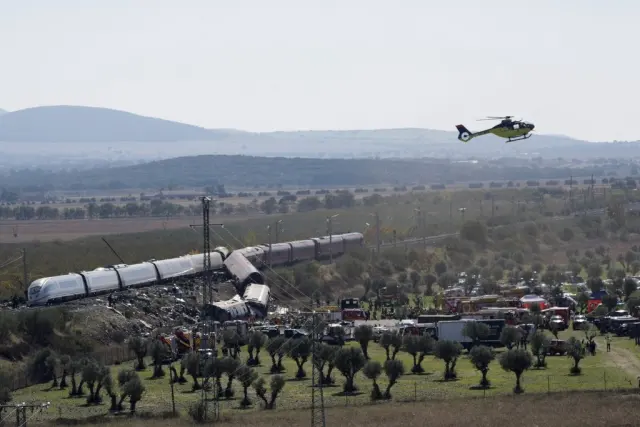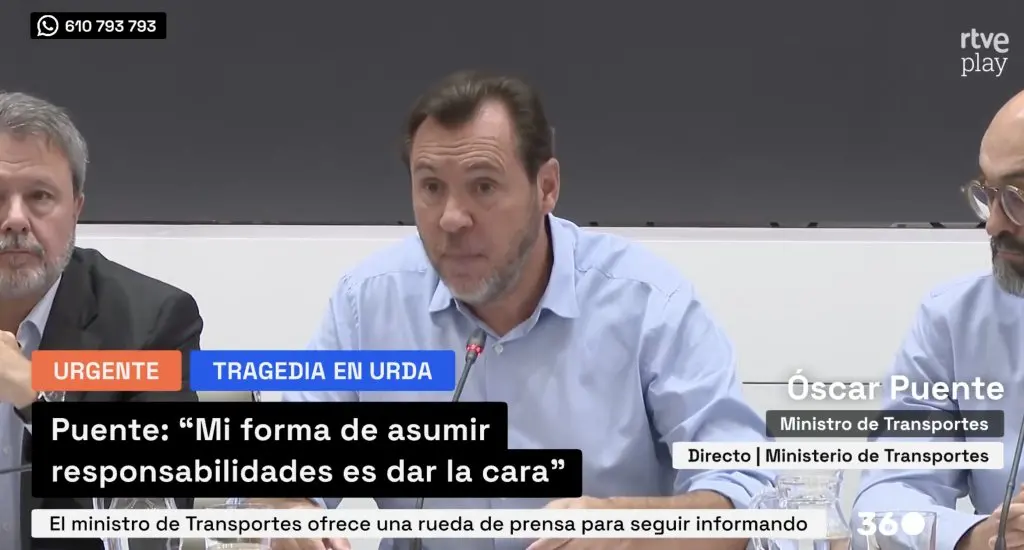
Spain's Transport Minister Óscar Puente has refused to resign as investigators piece together how a high-speed collision near Toledo in Castilla-La Mancha killed at least 69 people on Wednesday, in the country's second major rail disaster this year.
The crash happened after a computer failure knocked out the LZB train protection system on the Madrid–Seville line, halting several trains. Control-room staff at Adif's Atocha centre in Madrid then authorised movements manually. According to the minister's account, a Renfe AVE train carrying 379 passengers was cleared to move at normal speed — the procedure requires a maximum of 40 km/h under those conditions — while an Iryo train with 147 passengers sat stationary ahead on the same track. A signal switched to green even though the Iryo never restarted, which meant the ASFA warning system couldn't alert the approaching driver. Investigators from AITAT estimate the AVE hit the stationary train at 160–200 km/h.
That is the second catastrophe involving Renfe and Iryo in nine months: January's collision at Adamuz killed 46, pushing the combined toll past 115. Unions are pushing back against the focus on controller error, arguing the repeated failure of the LZB system deserves scrutiny — Puente himself disclosed it had failed 170 times this year, which he called within European norms. Attention has also fallen on a delayed upgrade: Adif awarded Thales España a €93.8m contract in 2021 to install the modern ERTMS signalling system on the Madrid–Seville route by early 2026, but the work passed to Hitachi Rail in 2024 and remains unfinished.
Politically, the disaster has exploded ahead of Spain's 29 November general election. The opposition People's Party is demanding Puente's resignation, unions want him dismissed, and Prime Minister Pedro Sánchez has conceded that public confidence in high-speed rail has been damaged. At the crash site, forensic teams had completed 49 autopsies and formally identified five victims by Friday, with regional president Emiliano García-Page warning the death toll could still rise.
Why it matters for travellers: Spain has one of Europe's most extensive high-speed networks, and the Madrid–Seville corridor is a staple route for visitors heading to Andalusia. If you're booking Renfe or Iryo trains in the coming weeks, expect delays, heightened safety checks and possible timetable changes while investigations continue. The political fallout and election campaign may also keep rail safety in the headlines through late November. Travellers currently holding tickets on affected routes should monitor operator updates, and anyone uneasy about the Madrid–Seville line can consider alternative transport until the investigation clarifies what went wrong.