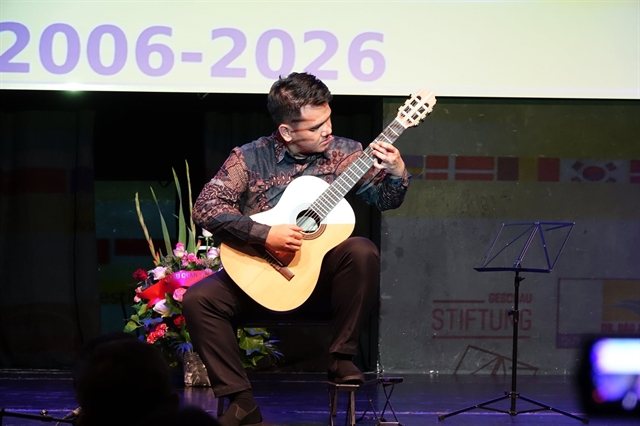
The quietest moment at a Berlin guitar competition came from a southern Vietnamese bedtime song. When Indonesian guitarist Theduardo Prasetyo played the opening notes of Ru Con — a traditional lullaby in which a mother sings her child to sleep — the room at Ballhaus Berlin went still. He went on to take first prize at the 20th International Guitar Competition & Festival Berlin (IGCFB), and several listeners later admitted they were moved without understanding a single Vietnamese word.
The version he played was arranged for classical guitar by Professor Đặng Ngọc Long, the Berlin-based Vietnamese guitarist who founded the festival in 2006 and still runs it as artistic director. For him, the arrangement is a way of exporting not just a melody but what he describes as the cultural soul of Việt Nam.
Here's what makes this festival unusual: every contestant, whatever their own repertoire, must perform three compulsory pieces drawn from Vietnamese folk music, composed or arranged by Long. That rule has held for all 20 years, and it has quietly produced results. Hundreds of young guitarists from around the world have learned Vietnamese folk melodies for the competition, then carried them home to audiences who might otherwise never hear them. This year's edition drew 30 contestants from 15 countries; after several rounds, five made the final. Prasetyo topped the podium, with prizes going to players from Italy, South Korea, Germany and France behind him.
The timing carries extra weight. The anniversary edition coincided with 50 years of diplomatic relations between Việt Nam and Germany, and 2026 will mark 15 years of their strategic partnership. The festival has long had institutional backing — Germany's Federal Foreign Office, the Goethe-Institut and the German Musicians' Association among them — and Vietnam's ambassador to Germany, Nguyễn Đắc Thành, used the occasion to praise Long for building a cultural bridge the Vietnamese community in Germany can point to with pride.
Why should a traveller care? Because this is soft power in its most listenable form. A competition entry from Berlin, played on a Spanish instrument, based on a southern Vietnamese lullaby, performed by an Indonesian musician — and understood by a German audience without translation. If you're heading to Việt Nam, it's a reminder that the country's folk traditions are alive well beyond its borders, and that a humble lullaby can be as much a cultural ambassador as any festival or monument. Consider it an unexpected detour for your playlist before the trip: hearing Ru Con in situ, sung by a grandmother in the Mekong Delta or arranged in a Hanoi concert hall, will land differently once you know it has already conquered a Berlin stage.
Sometimes, as Long put it, the most powerful cultural message needs no words at all.