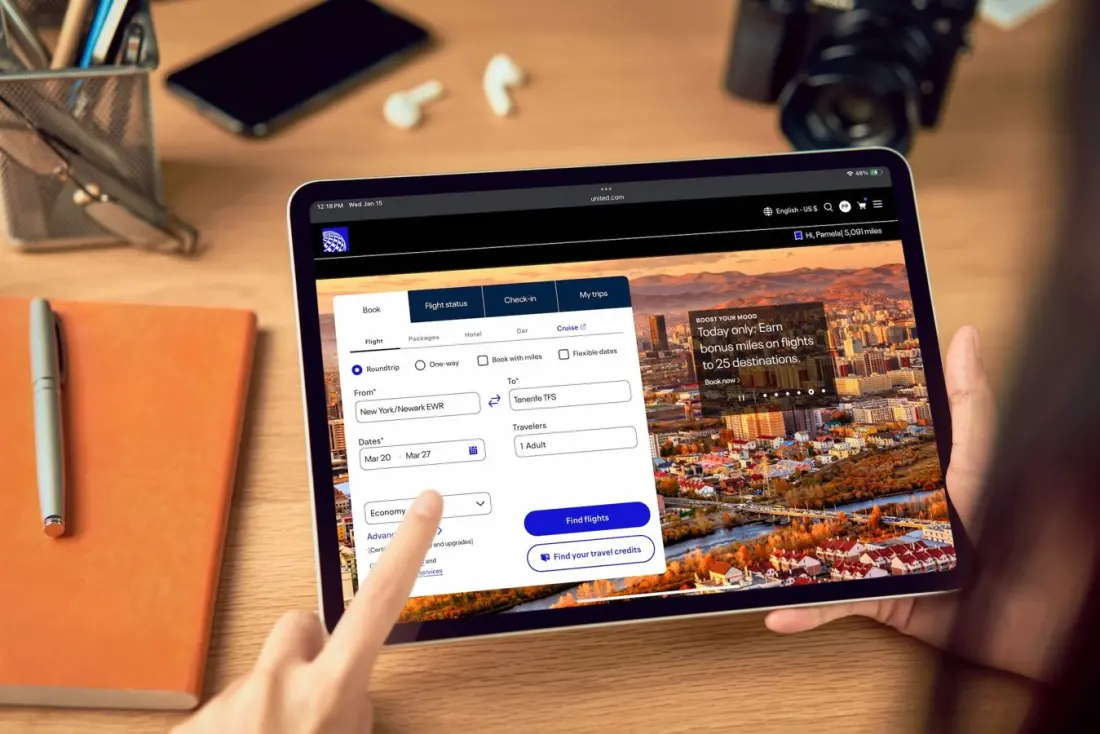
United Airlines quietly rewrote its ticketing rules on November 11, adding a new prohibited practice: using AI agents to "make, modify or service a ticket, and/or purchase any service or product." That covers autonomous assistants and even semi-autonomous ones you personally supervise and approve, whether they act through United's digital platforms, travel agencies or aggregators.
The airline frames the ban as customer protection. Sharing your MileagePlus credentials with a third-party tool could expose sensitive data, trigger unwanted purchases or account changes, or sidestep required acknowledgements — like the hazardous materials declaration passengers must confirm at check-in. Those are legitimate worries, but they don't fully explain why software can't perform a change you've explicitly authorised and could make yourself.
Here's the more interesting theory, laid out by Live and Let's Fly: United is getting ahead of automated fare-shopping before it becomes normal. Today, fare alerts tell you a price dropped, but the work is still on you — check the rules, compare restrictions, decide if rebooking actually saves money. An AI assistant could do all of that continuously and then act. Picture an $800 ticket whose fare rules allow rebooking at a lower price with the difference returned as flight credit. The fare drops to $650, your assistant rebooks and banks $150. It later falls to $575, and another $75 is captured. Same flight, $225 in credit — money most travellers would never claim because they assume the transaction is finished once the confirmation email lands.
Multiply that across millions of reservations and airline revenue management gets uncomfortable. Revenue models depend on passengers behaving in predictable ways; a machine that never stops shopping breaks the assumption. Scott Kirby, United's CEO, was candid about it at a Chicago event, telling The Wall Street Journal: "To be honest, I don't want to create another middleman."
As for the safety argument, the counterpoint is that good permissions design solves most of it. A responsible assistant could pause and require you to personally complete a hazmat acknowledgement, or restrict what software can touch in your account. Banning the entire category — including supervised use — looks less like protection and more like control of the customer relationship. Notably, United isn't eliminating fare alerts; what it's blocking is an agent acting on what it finds.
Why it matters to you: if you fly United, your existing fare alerts and manual rebooking still work fine — for now. But if you were hoping to hand reservation management to an AI tool, that door is closed on this airline, and it may signal how other carriers respond as consumer AI booking tools mature. The broader takeaway is that the next battleground in air travel pricing may not be fares themselves, but who is allowed to watch them on your behalf.