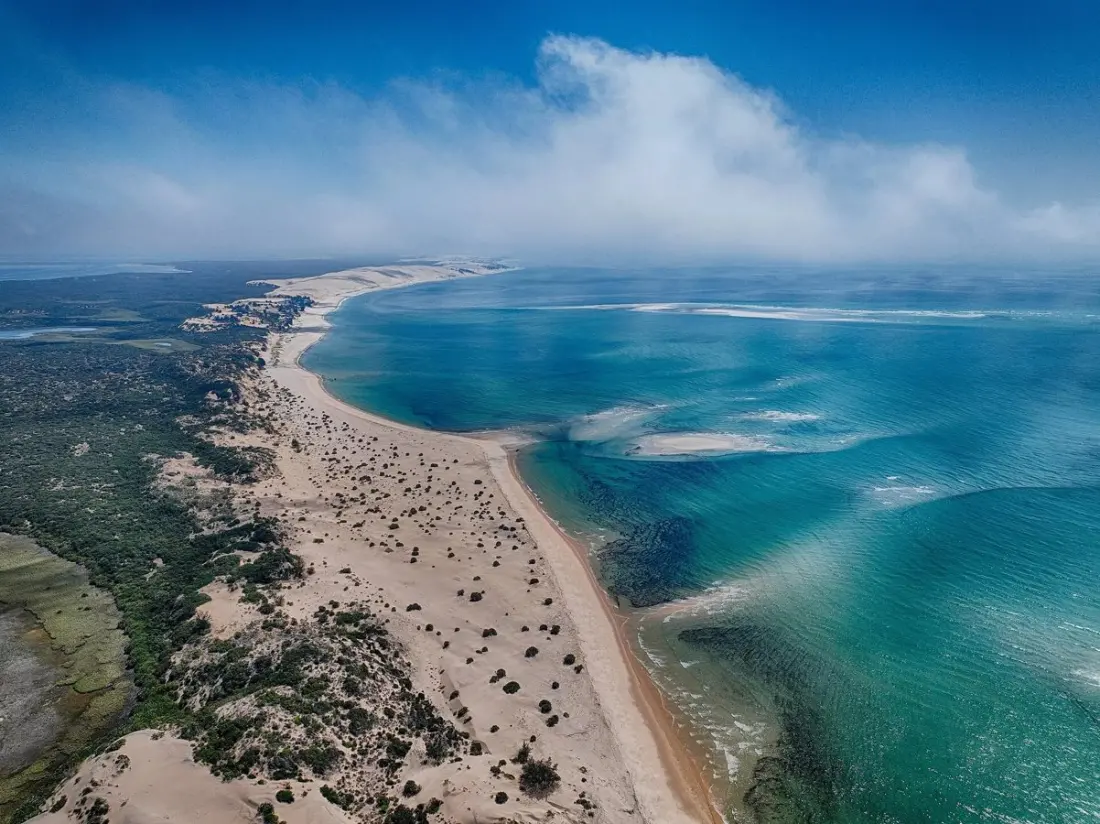
Off Mozambique's Bazaruto Archipelago, divers have found something odd on the seabed: reefs made not of coral, but of ancient forest. Thousands of years ago, coastal forests and wetlands covered ground now claimed by the Indian Ocean. Rising seas flooded the land around 5,000 years ago, and the buried plant matter slowly compressed into peat. As waves and shifting sand eroded the seabed, chunks of that peat were exposed — and their rough, crevice-riddled surfaces turned out to be ideal real estate for marine life.
Researchers dated samples from the formations to between roughly 300 and 5,000 years old, confirming they came from land plants rather than anything marine. The result is a reef system with an origin story unlike any coral structure nearby.
It's not just a curiosity. Surveys in 2023 recorded fish, sharks, rays and turtles hovering around the peat reefs. Juvenile snappers and grunts sheltered among the formations, while spiny lobsters claimed the cracks and ledges. Each of the three sites surveyed supported 26 to 36 small fish species — a modest count next to the 54 recorded on a nearby coral reef, but significant given how little hard seabed exists in the area. Scientists think the peat formations could serve as nursery grounds where young fish would otherwise have nowhere to hide.
There's a fragility to them, too. Cyclones, storms and moving sand can erode or bury the exposed peat, and researchers are still working out how much carbon the deposits store. They also suspect similar forest-reefs exist elsewhere — wherever coastal peatlands were drowned by rising seas — with Southeast Asia, the Caribbean and West Africa flagged as likely candidates. More surveys are needed to confirm how widespread they are.
Why should a traveller care? If you're heading to Bazaruto for its famous dugongs, whales and world-class diving, this adds a genuinely rare sight to the itinerary: reefs that began as trees. It's also a nudge to dive with operators and guides who understand and respect these fragile formations — unlike coral, damaged peat can't regrow the same way.
Bazaruto itself remains one of southern Africa's premier marine destinations, a protected national park of sand dunes, seagrass meadows and five main islands reachable by boat from Vilanculos. Knowing the seabed beneath it holds a drowned landscape gives an extra layer to any dive or snorkel trip here. The ocean, it turns out, is still full of surprises — and some of its best habitats started life on dry land.