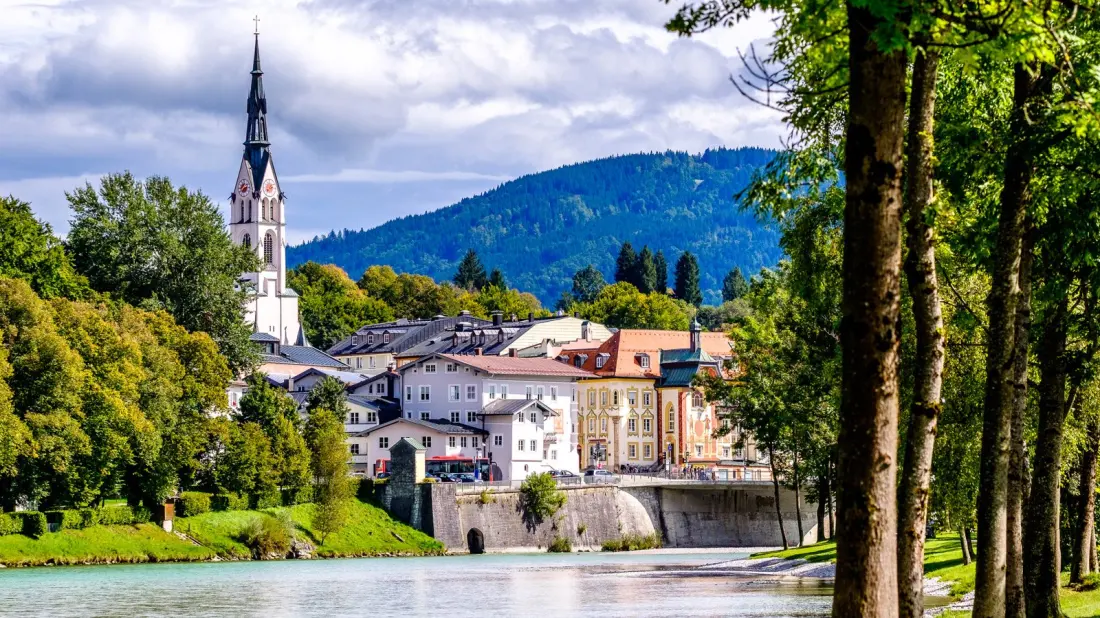
Bad Tölz doesn't try to impress you — it just gets on with being a textbook Bavarian small town. It sits on the Isar River roughly an hour south of Munich, close to the Austrian border, with the Alps stacked up behind it. An arched bridge, the Isarbrücke Tölz, leads into an Old Town of painted facades and louring gables, and that's before you've touched a trail or a thermal pool.
The town's whole identity comes from water. Iodine springs were found here in the 1800s, and the 'Bad' in the name — German for 'bath' — is an official title only granted to places meeting strict standards on mineral water quality and medical treatment. Public iodine baths have closed, but local spas still use the region's mineral-rich mud for therapy, particularly for minor joint and muscle pain. There's also Kneipp therapy, a holistic water-and-lifestyle method developed by a Bavarian priest that's said to help circulation, immunity, and migraines. The Kneipp Garden is free to visit from May to mid-October, which is a rare deal in spa country.
If you'd rather be pampered indoors, two names stand out. The family-run Hotel Alphenhof has an aromatic steam bath, indoor heated pool and whirlpool. Hotel Bergeblick, at the foot of Mount Blomberg, is adults-only and minimalist in style but not in amenities — its SENSES Spa includes an outdoor pool heated by a wood-chip system.
The Alps make this a year-round proposition. Summer means hiking and cycling, with an easy 15-minute climb from Marktstrasse or the river bridge up to Kalvarienberg Church, an 18th-century baroque church overlooking the town. Winter flips the script: the surrounding mountains serve up skiing, snowshoeing, and — a local speciality — tobogganing. There are three runs, from a gentle family track of about 1.5 miles to a fast 2.3-mile descent of the Blomberg, reached via the Blombergbahn cable car. Ride it to the summit at 4,055 feet and, on clear days, you can reportedly see Munich in the distance.
Back in town, wander Marktstrasse and look up: the buildings are covered in lüftlmalereien, traditional fresco murals showing religious and folkloric scenes. The Tölzer Stadtmuseum has some of the most elaborate facades and covers local history and crafts. Come in December and the town adds a Christmas market to the mix.
Why it matters: Bad Tölz works as a low-effort Alpine base. It's an easy day trip or overnight from Munich by car or train (about an hour either way), and Innsbruck is roughly 90 minutes by car if you're combining countries. You get spa culture, genuine hiking and sledding terrain, and Old Town charm without the crowds or prices of bigger Bavarian resort names.