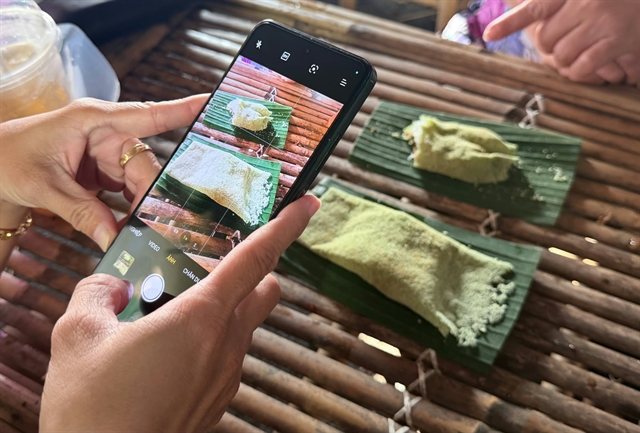
Somewhere between a pancake and a parcel, bánh rây — called om chiếl in Khmer — might be the most unusual cake you'll eat in southern Vietnam. Its name literally comes from the rây, the sieve used to make it, because that's the whole trick: the batter is never rolled, moulded or poured, but shaken straight through a sieve onto a hot, dry pan.
The flour is glutinous rice, soaked, ground and kneaded with pandan leaf extract until it's just moist enough to bind the second it hits heat — but not so wet it turns mushy. The maker, working without any oil, circles a small sieve over the pan so the damp grains fall evenly and fuse into a thin, lacy, chewy shell. Too hot and it burns; too cool and it never sets. Once the shell forms, a filling goes on — grated coconut cooked with palm sugar, plus crushed roasted peanuts or mung beans — the edges get folded into a neat square, and the whole thing is lifted off onto a banana leaf. Total time: under a minute, which only looks easy.
Eaten warm off the pan, it's a layered thing: soft and faintly chewy outside, rich and sweet inside, with nutty crunch, that vanilla-like pandan perfume and the caramel warmth of palm sugar. A cup of hot tea alongside is the classic pairing. Seller Mỹ Xuyên in Long Xuyên says her customers range from teenagers sharing a snack to older folks chasing a taste of childhood.
What makes the cake more than street food is its role in Khmer community life in An Giang. Families hand-make bánh rây for major religious occasions — Chol Chnam Thmay (Khmer New Year), Sene Dolta (Ancestors Day) and robe-offering ceremonies — and bring them to local pagodas as offerings to the monks, then share the rest with neighbours.
It's also quietly evolved. Some makers now tint the batter pink with dragon fruit, orange with spiny bitter gourd, or purple with magenta plant, while others keep the natural white. The cake features at the annual Southern Traditional Cake Festival in An Giang and has become a popular souvenir for travellers to carry home — a good thing to know if you're passing through the Mekong Delta and want an edible gift that isn't another box of dried fruit.
For food-focused travellers, this is exactly the kind of regional speciality worth building a morning around: cheap, made in front of you, and rooted in a culture you won't encounter in the same way anywhere else in Vietnam.