A collapsed slope on Langtang Lirung in Nepal has put a spotlight on an under-reported driver of glacier loss: soot. On 26 August, an ice-rock avalanche tore off the north face of the 7,227m peak, unleashing a debris flood that swept across Nepal and into China. Scientists say record temperatures were the trigger, but a new World Meteorological Organization bulletin confirms that airborne 'black carbon' is quietly speeding up the melt across the Himalaya.
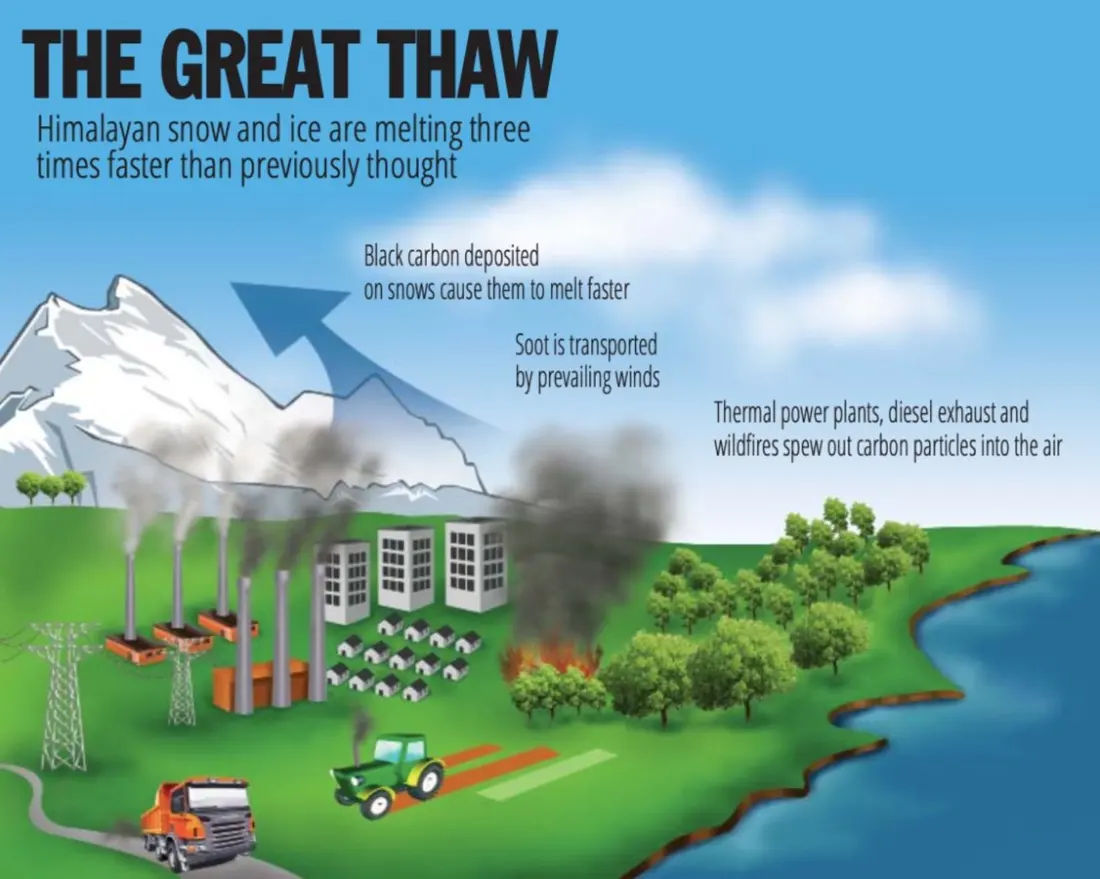
Black carbon is fine particulate matter — smaller than 2.5 microns — produced by diesel engines, coal-fired industry, firewood and crop burning. When it settles on snow, it darkens the surface, cuts the ice's reflectivity, and makes it absorb more sunlight. A study by ICIMOD on Yala Glacier in the Langtang region found that India and Nepal together account for 69% of the black carbon hanging over the central Himalaya, and that the sooty layer contributed 39% of the glacier's melt in the pre-monsoon season alone.
The pollutant packs an outsized punch. It has roughly 1,500 times the warming impact of CO2 per unit, and can boost atmospheric solar heating by up to 50%, according to ICIMOD researchers. It's also short-lived — a week or so in the air — which means cutting emissions from vehicle exhausts, brick kilns, household fires and crop stubble burning would pay off almost immediately. Household fires alone make up nearly half of global black carbon emissions.
Scientists caution against blaming the Langtang collapse solely on soot. Avalanches typically result from a mix of thawing, internal glacier instability and structural weakness, and no one has yet measured how much black carbon played a part. But the mechanism is well documented: as glaciers melt, dark bare rock is exposed, which absorbs more heat and thaws ice and permafrost further — a vicious cycle the WMO warns will intensify as wildfires and dust storms increase in a warmer climate. The agency has launched an Atmospheric Deposition Initiative to map where these pollutants are landing worldwide.
For anyone trekking in Nepal's Langtang Valley — or anywhere in the Himalaya — the findings are a reminder that the region is changing fast. Trailheads, ridgelines and glacial valleys that appear stable on a map may be less so in reality, and mountain weather and route conditions deserve fresh local checks before every trip. The story also reframes air pollution: the smog over South Asia's cities isn't just a health hazard, it's a direct contributor to the loss of the ice that feeds the region's rivers. Cleaner kilns, better vehicle standards and clean cooking energy could slow the melt — good news for trekkers, and for the hundreds of millions downstream who depend on that water.
Why it matters: Himalayan glaciers supply water to one of the world's most densely populated regions, and their decline will reshape trekking routes, hydropower and village economies across Nepal over the coming decades. Travellers heading to Langtang or Everest regions this season should follow Nepal Tourism Board and local teahouse-network updates on trail conditions.