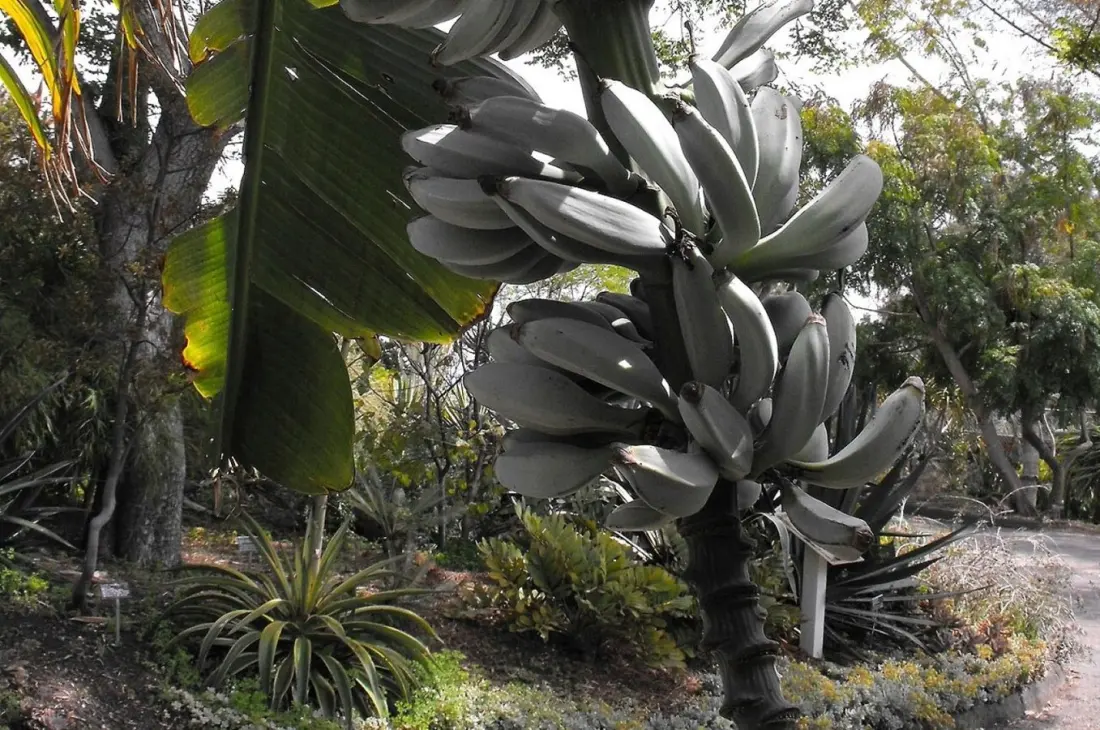
There's a banana out there that looks like it was dipped in metallic blue paint. The Blue Java, better known by its nickname the Ice Cream Banana, develops a silvery-blue skin while unripe — and its flesh is famously creamy, with a flavour people often compare to vanilla.
The colour trick is worth understanding before you hunt one down at a market: the blue lives only in the skin, and it comes from a natural waxy coating rather than any blue pigment in the fruit itself. Inside, the flesh is white or cream-coloured. As the banana ripens, the skin fades to pale yellow, so the dramatic blue stage is a brief one. The fruits run roughly 18 to 23 centimetres long.
Genetically, the Blue Java is a hybrid descended from two wild banana ancestors, Musa acuminata and Musa balbisiana, with roots in Southeast Asia — the Philippines and Indonesia are often cited as its heartland. From there it has spread widely: it now grows in Hawaii, Fiji, Australia, Central America, the Canary Islands, and parts of the mainland United States with warm-enough climates. The plants are giants, reaching 4.5 to 6 metres tall, with big leaves that carry a silvery-green sheen. Compared with many tropical bananas, they're also notably tough — better at handling wind and cooler temperatures, which partly explains how far they've travelled from their Asian origins.
The flavour is what has made the variety a social media favourite. Growers describe a sweet, aromatic fruit with a texture closer to custard than to a standard Cavendish, and the vanilla comparison — hence the alternative name Vanilla Banana — is really about that smooth consistency. Growers are quick to say it doesn't literally taste like a scoop of ice cream, but the creamy flesh means it shines in exactly the sorts of things you'd want it to: smoothies, milkshakes, pies and banana bread.
The most fun use, though, is 'nice cream': freeze the ripe fruit, blend it, and you get a soft-serve-style dessert with no dairy involved at all. That trick is a big part of why the Ice Cream Banana nickname has stuck so firmly.
Nutritionally, the Blue Java isn't doing anything exotic. Like other bananas, it delivers potassium, vitamin C, vitamin B6, magnesium and fibre, with the exact amounts varying by ripeness and growing conditions.
Why should a traveller care? Because this is the kind of thing you can't easily find at a supermarket back home. If you're heading to Hawaii, Fiji, the Canaries or anywhere in the tropical belt where it's grown, keep an eye out at local markets and roadside stalls — spotting one in its blue phase is a genuine novelty, and tasting it ripe is a small food adventure in itself. The story is a good reminder that the humble banana is a far more varied fruit than most of us ever get to see, with dozens of varieties traded locally around the tropics that never make it onto export shelves.
Colombia One