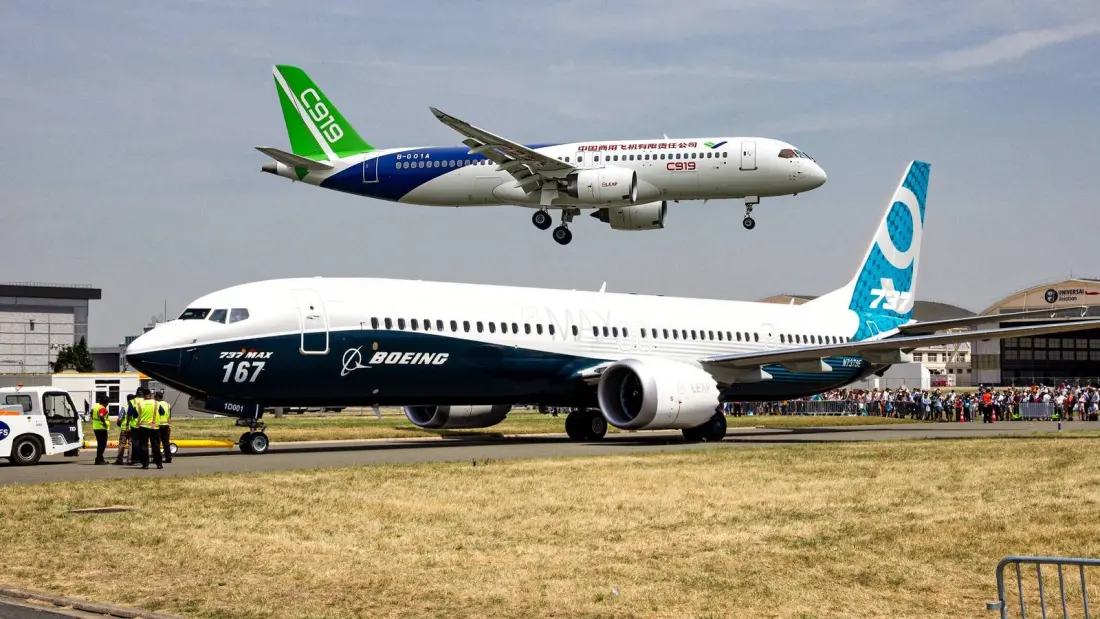
On paper, the Boeing 737 MAX and China's COMAC C919 are natural rivals: twin narrowbody jets that anchor the aviation ambitions of the United States and China respectively, powered by the same CFM LEAP engine family (the -1B for the MAX, the -1C for the C919). In practice, the gap between them in 2026 is enormous.
The numbers tell the story. Boeing had delivered 2,399 MAX jets by late August this year, including 57 in September alone, and holds a backlog of 4,537 aircraft. COMAC, by contrast, had just 31 C919s in service at the start of 2026, spread across Air China (12), China Southern (13), China Eastern (17 including earlier deliveries), plus a handful of house jets. Aviation consultancy IBA forecasts a modest 26 deliveries in 2026, rising to only 93 by 2030, bringing the in-service fleet to roughly 322 jets.
The C919's problems are partly homegrown, partly political. It relies heavily on Western components, and when the US suspended LEAP-1C engine export licences in May 2025, production took a serious hit. The ban was lifted on 4 July 2025, but COMAC's manufacturing rhythm hasn't recovered. China's embassy called the restrictions a malicious suppression of its industry.
As an aircraft, the C919 is respectable but unremarkable. Against the MAX 7, it's slightly longer and carries more seats in Chinese configurations (164 on China Eastern jets), with near-identical wingspan. Its big weakness is range: around 2,235 nautical miles versus 3,800 for the MAX 10. That matters less than it might, since the jet is effectively limited to Chinese domestic routes anyway. It also leans on older technology — about three-quarters of its weight is aluminium-lithium alloy, with composites making up just 12%. Its first international flight only happened in August, a short hop from Beijing to Ulaanbaatar that Western analysts dismissed as a PR exercise.
Where the C919 genuinely wins is safety record: no fatal accidents or hull losses in service. The MAX, scarred by the 2018 and 2019 crashes and the January 2024 door-plug incident, has racked up an estimated $19–20 billion in direct losses and remains under aggressive FAA oversight. Still, it's a global workhorse — United even flies it across the Atlantic to Glasgow, Madeira and Santiago de Compostela.
For travellers, this rivalry is mostly a spectator sport for now. If you're flying domestically within China, you may well find yourself on a C919 with Air China, China Eastern or China Southern — a genuine novelty for aviation fans. Elsewhere, the MAX remains the default on short and medium-haul routes. The real significance is geopolitical: Beijing wants COMAC to challenge Boeing and Airbus in the fast-growing Asia-Pacific market, where airlines are frustrated by delivery delays, and regional bodies like AAPA are openly welcoming a third supplier. But at 26 jets a year, that challenge is still a long way off.