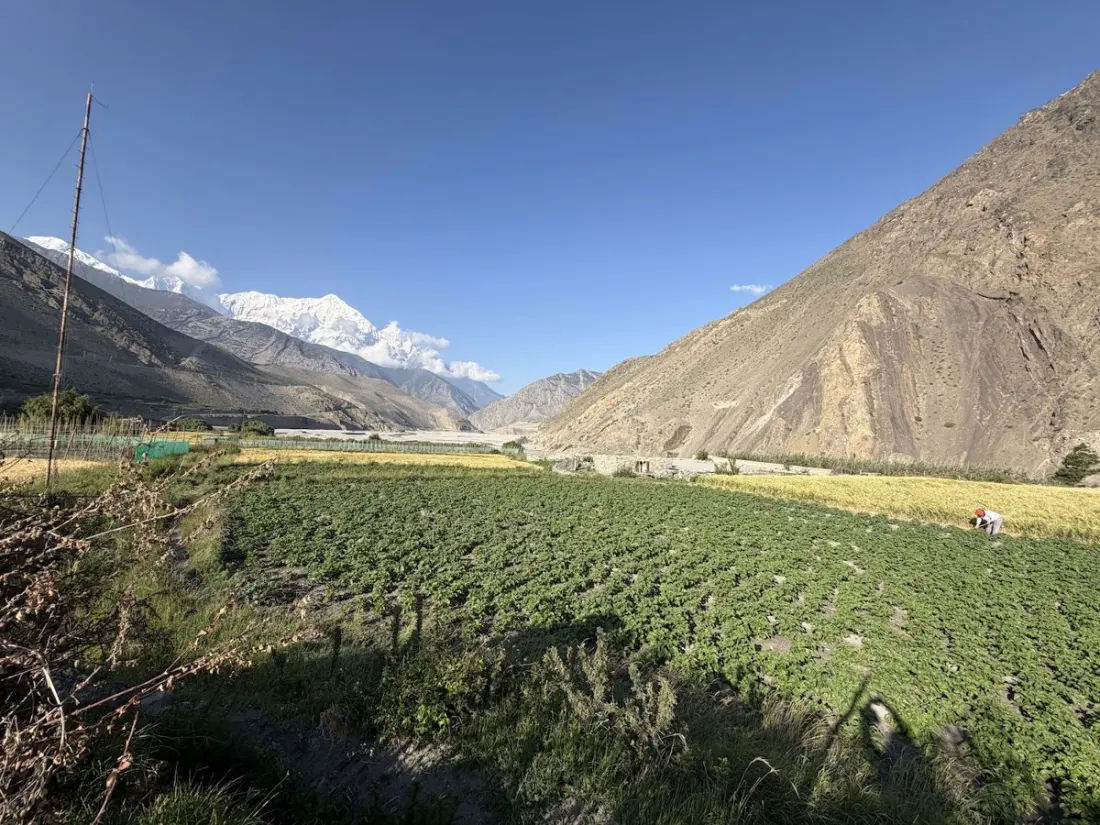
In Nepal's trans-Himalayan Mustang district, autumn used to bring a familiar patchwork: red and gold fields of buckwheat, millet and barley lining the Kali Gandaki river at villages like Kobang, Lete and Tukuche. Before sowing barley — known locally as uwa — families would gather in ceremonial dress for prayers led by the head lama, with offerings of seven kinds of flour placed on a stone at the centre of the field. Those scenes are becoming rare.
The reason is a triple squeeze: young people leaving, cheap processed food arriving, and a climate warming fast. Mustang's official data shows the maximum temperature rose more than 2°C between 1981 and 2014, and snow failed to arrive in eight of the last ten winters. Apples, once impossible this high, now thrive — and pay better. Farmers in Kagbeni and Tiri have ripped out barley and buckwheat in favour of orchards, with traders offering advances and a ready market in Pokhara and Kathmandu, plus demand from trekking lodges on the Upper Mustang and Dolpo routes.
The numbers are stark. Lower Mustang harvested 472 tonnes of barley in 2015; today it is about 91 tonnes. Buckwheat output has collapsed from nearly 1,000 tonnes a year. In Tiri village at 2,800m, only two of 17 households still planted barley and millet this year.
There's an irony in the apple story itself. The lower valley around Marpha and Thasang built its fame — and its brandy — on apples, but it is now too warm for them there. New pests like codling moth and San Jose scale add to the trouble. Apple farming is climbing uphill: the government's horticulture research centre in Marpha has bought 40 hectares in Ghemi at 4,000m, an altitude where apples never previously grew.
For travellers walking the Annapurna Circuit or trekking into Upper Mustang, this is a changing landscape in real time — orchards where grain terraces were, and harvest festivals becoming memories rather than events. What's being lost isn't just crops. Locals describe planting season as a village festival, food as nourishment for culture as much as body. Nepal's national Genebank is now launching a conservation programme in Mustang and Manang, warning that over half the indigenous knowledge in these areas has already vanished. Naked barley, buckwheat and foxtail millet are on a red list of disappearing crops — even though they are nutritious and better adapted to a harsh, changing climate than many newer arrivals.
Why should a visitor care? Because the buckwheat noodles, millet flatbreads and local barley dishes on lodge menus are tied to this fading farming culture — and ordering them, buying local grain products, or simply asking farmers about their fields supports what remains. Mustang is still one of Nepal's most rewarding regions to walk, with medieval walled-town Lo Manthang at its heart, but the living heritage that makes it special is thinner than it was a decade ago. The farmers interviewed here put it plainly: profit has risen, but a way of life is eroding with the crops.