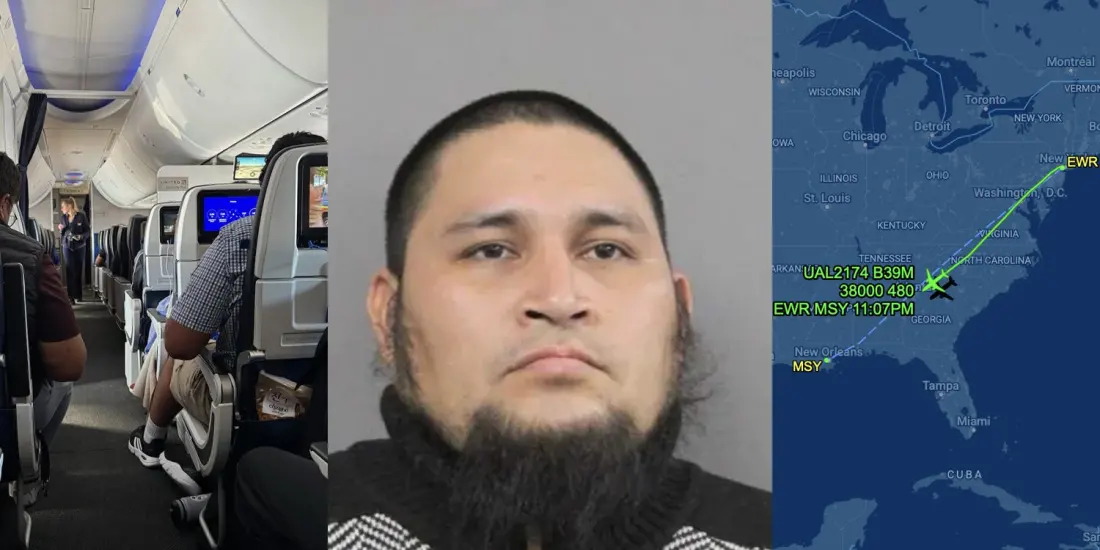
A United Airlines flight from Newark to New Orleans ended with police at the gate after a passenger allegedly claimed there was a bomb on board and tried to reach the cockpit. The aircraft landed safely and the man was arrested — but the story has since grown larger than the incident itself, thanks to an unusual immigration history revealed by the Department of Homeland Security.
The passenger, identified as 34-year-old Rony Alexander Gomez-Alberto, was on United flight 2174, a Boeing 737 MAX 9 carrying 46 passengers and six crew members. According to the Jefferson Parish Sheriff's Office, he told cabin crew there was a bomb aboard; DHS separately alleges he attempted to force his way into the cockpit. Deputies met the plane when it landed at New Orleans around 11:10 pm on November 9, and booking charges include communicating false information about planned arson and terrorizing. The FAA has confirmed it will investigate the disturbance.
What has drawn the most attention, though, is what DHS disclosed afterwards. The agency says Gomez-Alberto was caught entering the United States illegally in 2011 and again in 2014, and was deported both times. A third encounter with Border Patrol happened near San Ysidro, California, in 2019. An immigration judge ordered him released pending removal proceedings in January 2020, and DHS says a judge later granted asylum on a claim of feared persecution for being transgender. ICE has now lodged a detainer with the local sheriff's office.
DHS Secretary Markwayne Mullin framed the case as evidence of a broken asylum system, accusing the suspect of gaming his way into the country. The site that broke down the case, Live and Let's Fly, pushes back gently on the rush to judgement: two prior illegal entries don't tell us what the immigration judge actually saw or weighed, and the full asylum decision hasn't been made public. The alleged conduct on the plane is serious and frightening — but it doesn't, by itself, prove the original persecution claim was fake. The fair questions are about what officials knew, when, and whether any warning signs were missed.
For anyone who has ever flown, the human core of this is simple: 46 people on a night flight heard a bomb threat and watched someone allegedly head for the cockpit door. That's about as bad as an onboard disturbance gets, and the fact that the 737 MAX 9 landed without a cockpit breach is the genuinely good news here. There's no indication United should have denied boarding based on asylum history alone — the airline had no visible red flag to act on.
Expect this one to get heavily politicised in the immigration debate. For travellers, the practical takeaway is the usual one: crews and law enforcement handled a worst-case scenario exactly as designed, and it ended with everyone safe and a suspect in custody.