
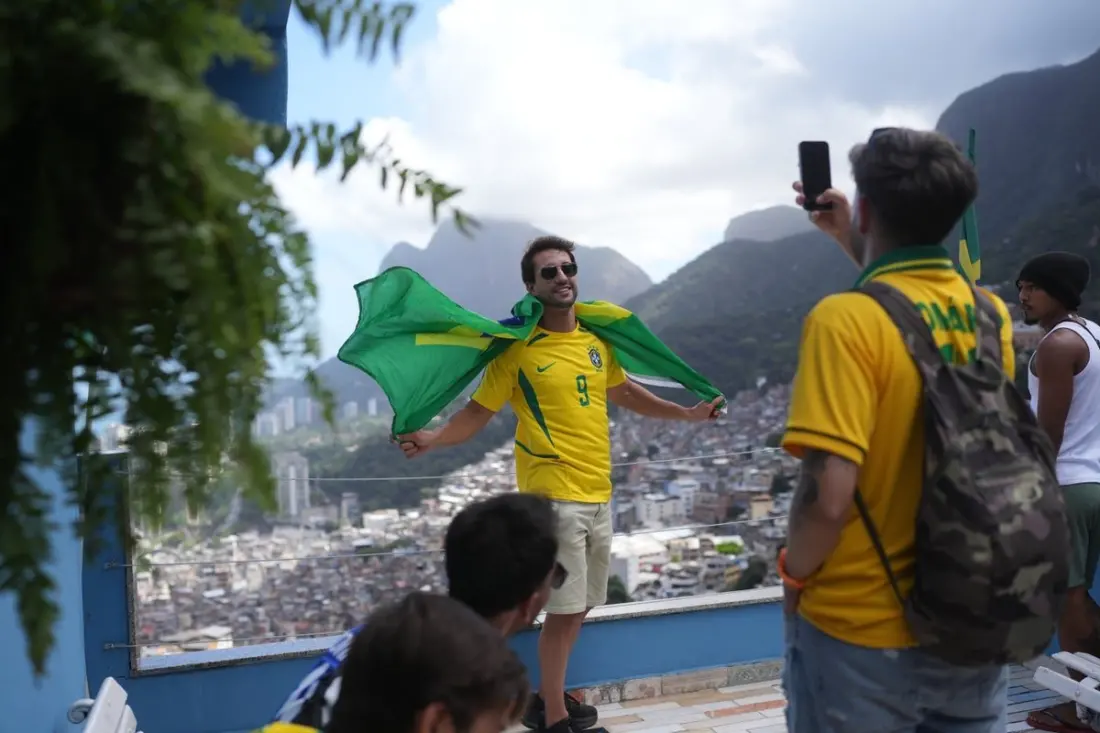
More than nine million international visitors arrived in Brazil last year, a 37% jump on 2024, and the country's cultural clout is expanding just as fast. From funk star Anitta to Oscar-nominated films like I'm Still Here and The Secret Agent, Brazil is suddenly everywhere — and travellers are following.
The catalyst, many trace back to 2023, when "Brazilcore" took off: a fashion trend built on the green, yellow and blue of the Brazilian flag. Celebrities from Bad Bunny to Hailey Bieber, Sabrina Carpenter and Addison Rae have all leaned in, and the look has filtered down to high streets worldwide — crochet pieces, micro-shorts, bikinis and football shirts, with everyone from Zara and H&M to Chanel, Jil Sander and Schiaparelli nodding to Brazil's national colours. Cultural researchers credit the trend's spontaneity and vivid palette as a reaction against rigid, uniform fashion — people simply wanted more fun.
But the phenomenon has outgrown fashion. It now spans music, dance, cinema and sport — a celebration of "brasilidade", or Brazilianness. Madonna, Lady Gaga and Shakira have each played free shows on Copacabana Beach in 2024, 2025 and 2026 respectively, each drawing at least a million people, according to Rio's city hall. Bruno Mars posted a viral video professing his love for the country (13 million Instagram likes and counting), complete with a Christ the Redeemer tattoo and a cameo from a caramelo — the caramel-coloured stray dog that has become an unlikely national symbol, central to a new wave of Brazilian self-confidence dubbed "caramelo pride".
Social media is doing the heavy lifting. In Rio's Rocinha favela, tourists now pay for drone-shot videos of themselves on a terrace overlooking the city — clips that keep going viral and pulling in more visitors. Local guide Vitor Oliveira says influencers were the "game changer" behind the tourism boom in his neighbourhood. Brazil's 200-million-strong, hyper-online population amplifies everything, turning content into memes and global references at speed, backed by a government push through tourism agency Embratur.
There's a catch worth knowing. Locals repeat the old saying that "Brazil is not for amateurs" — a nod to a country where Carnival exuberance coexists with real inequality and violence. Experts also warn the trend could cool, especially with upcoming elections and political polarization threatening to taint the joyful associations of yellow and green. As one São Paulo-based comedian observing the flood of Brazil content put it, the formula is getting tired.
For travellers, the takeaway is simple: go now, while the energy is at its peak — but treat the viral highlights as a starting point, not the whole story. The drone video in Rocinha is one experience; the country's food, music scenes, natural wonders and regional cultures go far deeper than any trend. Brazilians have long cycled through feelings of being under-appreciated abroad — the fabled "mongrel complex" — so showing genuine curiosity beyond the Instagram checklist will earn you warm welcomes in a country famous for them.