An art show in a forest is nothing new — but Colombia has just staged the first contemporary art exhibition inside a tropical dry forest, and it comes with a story worth the trip. The exhibition, called "Arrastres" ("What the River Carries"), sits in the Honda Botanical Garden in Honda, Tolima, a river town about three hours from Bogota, and runs from November 1 to December 15.
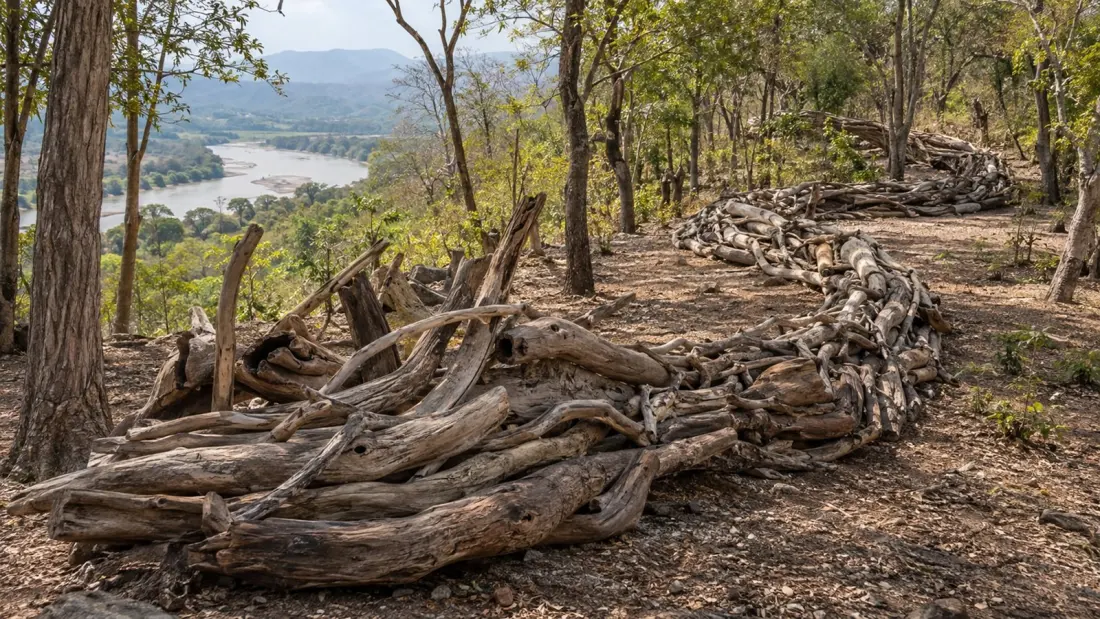
The centrepiece is a large installation by Sebastian Gomez Vargas, an artist from Bucaramanga, built from seven tons of wood fished out of the Magdalena River. Local fishermen from the Pacho Mario and Panchigua neighbourhoods gathered the driftwood through "leñateo" — the practice of collecting timber carried along by the current. The result uses that salvaged timber to echo the movement of the water itself, and it gives the fishermen a visible place in the artwork rather than a footnote.
The piece is not new to the road. It previously spent two months at the Trilladora Guali during La Magdalena Fest, supported by CoCrea, with free entry and evening openings. But in the forest it takes on different meaning: river debris resting among trees that survive on seasonal rain. The organizers — the botanical garden, the municipal government and the Cumula Foundation — frame the whole thing as a living classroom about an ecosystem most Colombians never encounter.
That ecosystem is in real trouble. Colombia has kept only about 8% of its original tropical dry forest, according to the Alexander von Humboldt Institute, and just 5% of what survives has legal protection. The forest grows in hot lowlands below 1,000 metres, where temperatures exceed 24 degrees Celsius and dry seasons stretch long. Around 87% of its woody plant species are rare, and researchers warn the forest could collapse within 50 years. A regional study ranked Colombia's dry forest areas among the ten least protected in Latin America.
The Honda Botanical Garden is part of the response. Since 2015 the Cumula Foundation has run the site on five hectares loaned by the municipality, working with the national botanical garden network, the Humboldt Institute and gardens in Ibague and at the University of Tolima.
The exhibition itself follows suit. There's a zero-plastic policy — only earth, wood and guadua, a giant native bamboo — and the anchoring techniques borrow from traditional Magdalena Medio architecture, so the artwork doesn't damage the forest it's defending.
For travellers, this is a reason to put Honda on a Colombia itinerary beyond the usual coffee-zone circuit. It's a compact, walkable combination of river culture, colonial streets and now serious contemporary art, all within a few hours of Bogota. The run is short — six weeks — so timing matters. If you can't make it, the botanical garden itself remains as a research and restoration site, and Honda's riverside Malecon makes an easy stop on any Magdalena valley route. An exhibition like this won't save a forest on its own, but walking through one while looking at what the river carries is a far more memorable lesson than any plaque.