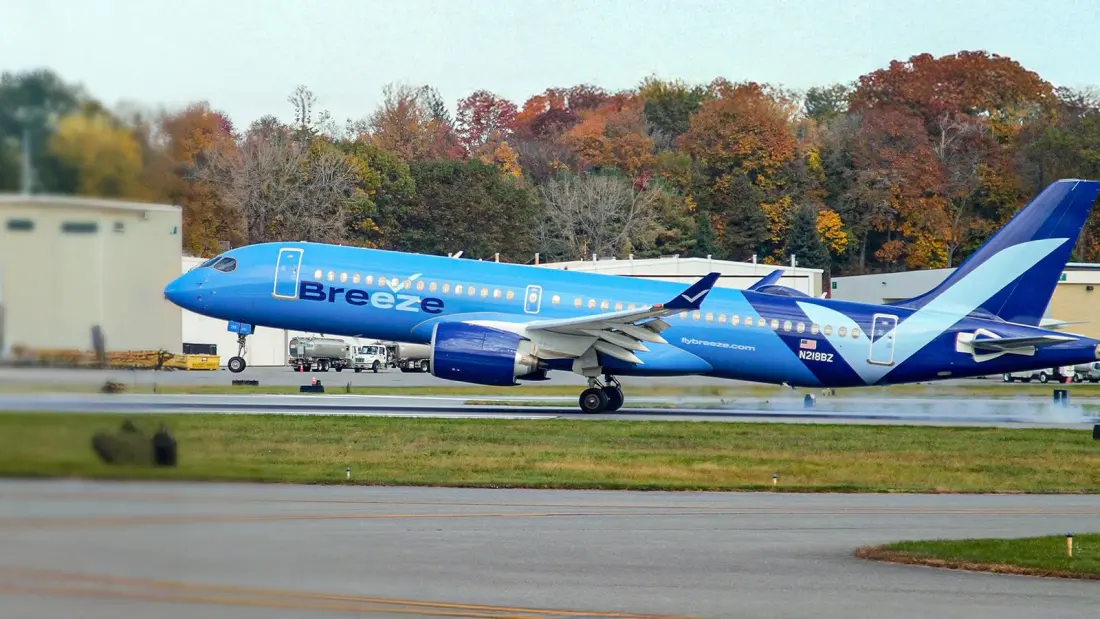
When Spirit Airlines stopped flying on May 2, 2026 — a Chapter 11 reorganisation that failed and slid into Chapter 7 liquidation, helped along by fuel prices above $4 a gallon — it left dozens of communities without any commercial air service at all. Most airlines have hung back. Breeze Airways hasn't.
The Utah-based carrier is cherry-picking routes Spirit abandoned, but with a clear rule: skip the big trunk corridors and go where demand is leisure-driven, competition is thin, and a couple of weekly flights will do the job.
The clearest example is Arnold Palmer Regional Airport in Latrobe, Pennsylvania, which lost its only commercial service when Spirit pulled out — a real blow for Westmoreland County residents and for the airport itself, which had just spent around $28 million expanding its terminal. Breeze will bring flying back with twice-weekly Myrtle Beach flights from February 9, 2027 (advertised from $49 one-way), then Orlando from May 26, 2027 (from $59). For locals, that means no more driving to Pittsburgh to catch a connecting flight. As ever with advertised intro fares, extras and availability will shape the final price.
Leisure routes like these suit Breeze's model. Holiday travellers will happily build trips around two departures a week, which lets the airline test new markets without committing daily capacity. Its busiest Spirit-era routes at Latrobe — Orlando (36,000 passengers), Myrtle Beach (20,000) and Fort Lauderdale (5,000) — are exactly the kind of family-vacation demand that works on limited frequencies.
Tampa is the other half of the story, and a bigger deal than the small-airport play suggests. Breeze is turning Tampa International into an international base, adding St. Thomas on December 16, Cancún on December 18 and Montego Bay on December 19, then twice-weekly year-round Santo Domingo service on June 18, 2027 using its Airbus A220-300. That makes Santo Domingo the airline's sixth international destination from Tampa, tapping both beach-holiday and visiting-friends-and-relations traffic without going head-to-head with the majors.
And that's the point: routes linking New York, Chicago or Atlanta carry huge volumes but also entrenched competition, heavy airport costs and corporate contracts Breeze can't realistically crack. Its A220-300 fleet — efficient, right-sized, with useful range — is built for point-to-point gaps between cities, not hub wars. For travellers, the upside is simple: nonstop flights from smaller airports at family-friendly prices, to places people actually want to go.
If you live near a secondary airport that lost Spirit service, keep an eye on Breeze's announcements — this looks like a playbook it intends to keep running.