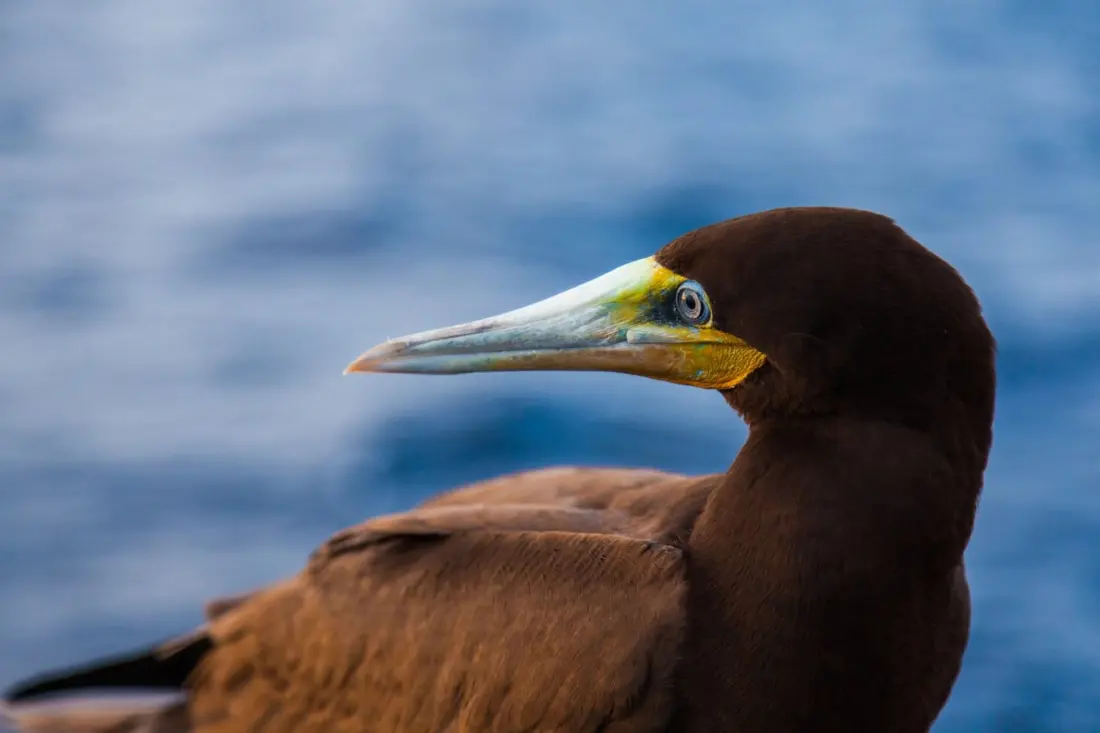
The brown booby has an unfortunate name and a serious work ethic. This sleek seabird, common along Australia's tropical north, hunts by folding its wings and rocketing into the ocean at close to 100km/h, then chasing fish underwater for several metres. Few birds combine that kind of aerial precision with such striking looks: dark chocolate plumage set against a pale head and belly, a dagger of a beak, and forward-facing eyes that give it sharp binocular vision for spotting fish schools from height.
You'll find brown boobies across tropical and subtropical waters worldwide — the Atlantic, Pacific and Indian oceans all host them. In Australia they're at home from Western Australia, across the Northern Territory and up through Queensland, with the occasional stray wandering as far south as New South Wales or Victoria.
But if you want to see them properly, Christmas Island is the place. The remote Indian Ocean territory holds roughly 7,000 breeding pairs — one of the largest brown booby populations on the planet. For birders and wildlife photographers, that density is hard to beat, and it stacks neatly alongside the island's other famous seabird spectacles, like the red crab migration and the Abbott's booby colonies.
Life in a booby colony isn't pretty. Brown boobies are unusual among their family in nesting directly on the ground, building simple scrapes from shells and vegetation. Space on crowded islands is scarce, so pairs fight for the best spots. Most lay two eggs, but usually only one chick makes it — the stronger sibling often shoves the weaker one out of the nest entirely. Grim, certainly, but it's a sensible strategy when food supplies swing unpredictably in open-ocean conditions, where fish schools appear and vanish in minutes.
For travellers, that raw colony drama is part of the appeal. Watching adults torpedo into the sea and return to squabbling chicks gives you a full wildlife documentary in a single viewpoint, no zoom lens heroics required — though a decent one helps. The birds' ground-nesting habit also means you can observe them at close range from designated paths, unlike tree-nesting species that stay hidden in the canopy.
Christmas Island suits a specific kind of traveller: someone happy with a remote destination, a small aircraft, and nature as the main event rather than a sideline. Timing matters if you want to combine boobies with other wildlife highlights, and the island's national park status means most visits revolve around guided walks and marked trails. Bring patience, a good camera, and respect for nesting sites — these birds work hard enough for their meals without tourists adding to the pressure.
Whether you're a dedicated twitcher or just after a trip with genuine 'you had to be there' moments, a colony of thousands of brown boobies plunging into the Indian Ocean should be on the shortlist.
Story via Australian Geographic.