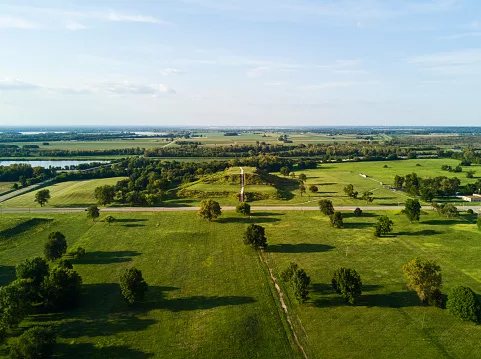
A thousand years ago, one of North America's largest cities stood on the banks of the Mississippi. Today its grass-covered earthworks rise quietly from farmland in Collinsville, Illinois, roughly 13km from downtown St Louis, and you can explore them for free.
Cahokia was a thriving Indigenous urban centre at its peak between AD 1050 and 1150, home to an estimated 10,000 to 20,000 people. It's now protected as the Cahokia Mounds State Historic Site and has held UNESCO World Heritage status since 1982. What survives is one of the most significant pre-Columbian cities north of Mexico — and one of the Midwest's most overlooked day trips.
Start with Monks Mound, the largest prehistoric earthen structure in the Americas. It rises about 30 metres and covers around six hectares, built up basket by basket over generations. A staircase leads to the flat top, where you get a view that sums the place up: ancient earthworks on one side, the St Louis skyline on the other. Give it more than a quick photo stop — the base and surrounding paths reward a slower wander.
Next door lies the Grand Plaza, a deliberately levelled open space that formed the heart of Cahokia's public life, hosting gatherings and ceremonies. At first glance it reads as flat grassland, but once you see how the mounds and spaces are positioned relative to each other, it becomes clear this was a carefully planned urban layout, not a random scattering of hills.
For something stranger, find Woodhenge: a reconstructed circle of large timber posts that archaeologists believe functioned as a solar calendar, marking solstices and equinoxes. It's a fascinating stop for anyone interested in how ancient societies tracked the seasons, and the site sometimes runs special activities around solar events.
Beyond the headline monuments, walking trails thread through the site, passing smaller mounds, prairie grassland and traces of the two-mile timber palisade that once encircled the city's centre and was rebuilt several times. Bring sturdy shoes, sun protection and water, especially in summer — this is open country with little shade.
The Interpretive Centre adds context on the people who built Cahokia, their agriculture and daily life, though note the cultural exhibition galleries are currently closed while the site reviews its collections in consultation with descendant Indigenous communities. The lobby — with its site model, canoe exhibit, gift shop and facilities — is open Wednesday to Sunday, 9am to 3pm.
Better still, take a guided tour: free walks covering Monks Mound at 10am and the Grand Plaza at 1pm run Tuesday to Sunday, each about an hour. Reservations are required, so book ahead. Entry to the grounds costs nothing, with donations welcome, and the outdoor area is open daily from dawn to dusk.
If you're visiting St Louis for the Gateway Arch or a ballgame, Cahokia makes an easy and genuinely different detour. A car helps, but the payoff is big: the chance to walk through one of ancient North America's great cities on an ordinary afternoon.