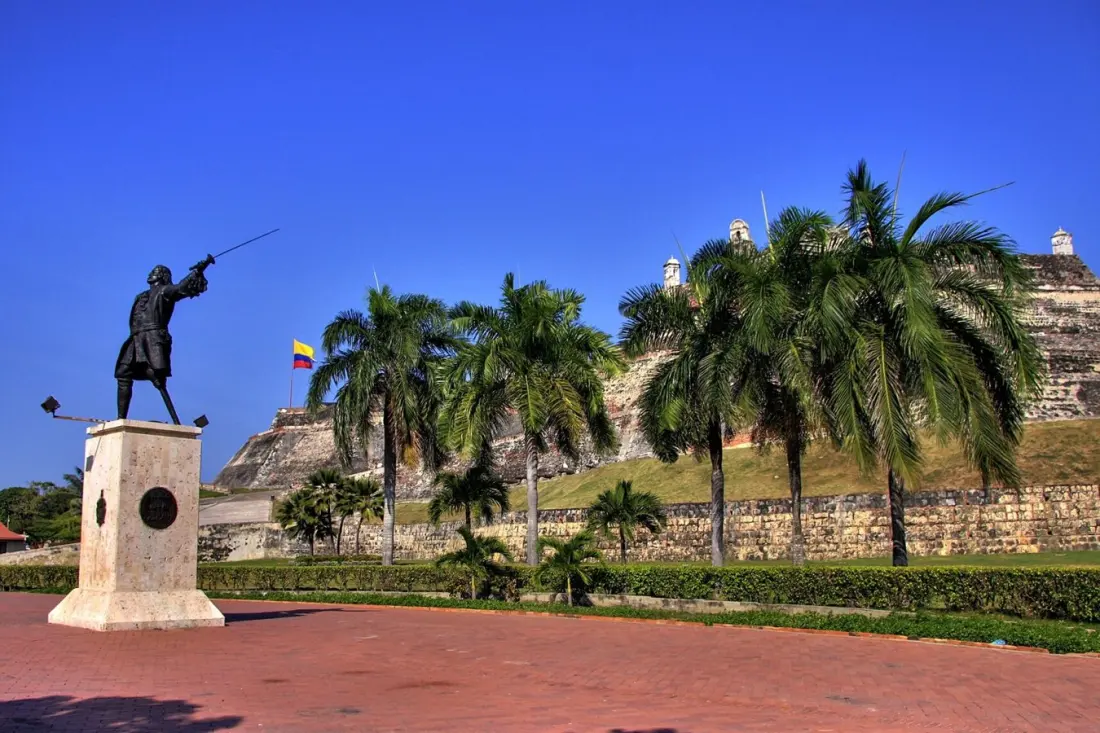
Picture the odds: in March 1741, Admiral Edward Vernon sailed into Cartagena de Indias with roughly 190 ships and up to 30,000 men — one of the largest naval expeditions of the century. Facing him were about 3,000 to 4,000 Spanish defenders and six warships, led by an admiral missing a leg, an eye and the use of an arm. By May 20, the British had given up and sailed home.
That admiral was Blas de Lezo, a Basque born in 1689 whose war injuries earned him the nickname Mediohombre, the "Half-Man." He lost his leg at the Battle of Velez-Malaga in 1704, an eye at Toulon and the use of his arm at the 1714 siege of Barcelona — none of which slowed a career that eventually brought him to Cartagena in 1737 to command the local Spanish squadron.
The stakes were huge. The attack came during the War of Jenkins' Ear, a trade-driven conflict between Britain and Spain, and Cartagena was a linchpin of Spain's Caribbean and transatlantic commerce. Vernon's force fought its way through the narrow Bocachica entrance to the inner harbour, but Lezo had planned for that: he scuttled ships to choke the approaches and pulled his forces back to the fortress of San Felipe de Barajas. The British assault on the fortress stalled, then unravelled as disease, shortages and tropical heat took their toll. News of the failure reached London in June 1741 and helped bring down Robert Walpole's government.
The siege is woven into Cartagena's old town, which visitors walk through today. The fortress of San Felipe de Barajas still dominates the city — you can climb its tunnels and ramparts and see exactly why the assault failed. The story has layers, too: in 1586 Francis Drake had sacked the then barely-fortified city and extracted some 110,000 silver ducats in ransom, and in 1815 Spanish general Pablo Morillo took it back after a brutal 106-day blockade during the independence wars. Lezo himself died in Cartagena in September 1741, months after his greatest victory, without ever seeing the fame it brought him.
For travellers, this history is precisely what makes Cartagena one of the Caribbean's most rewarding city breaks. The walled old town — a UNESCO World Heritage Site — is a dense grid of pastel colonial mansions, plazas and churches, all of it built on the wealth and fear that produced those walls in the first place. You can spend a morning on San Felipe's ramparts, an afternoon in the historic centre, and finish with the city's celebrated food scene.
It's a story that rewards a guided tour: local guides make sense of Bocachica, the Fort of San Luis and the chain of defences that turned a doomed port into the graveyard of the British Empire's American ambitions. Anyone with an interest in naval history, colonial architecture or just a photogenic Caribbean city with real substance will get plenty out of a few days here.
Story based on reporting by Colombia One.