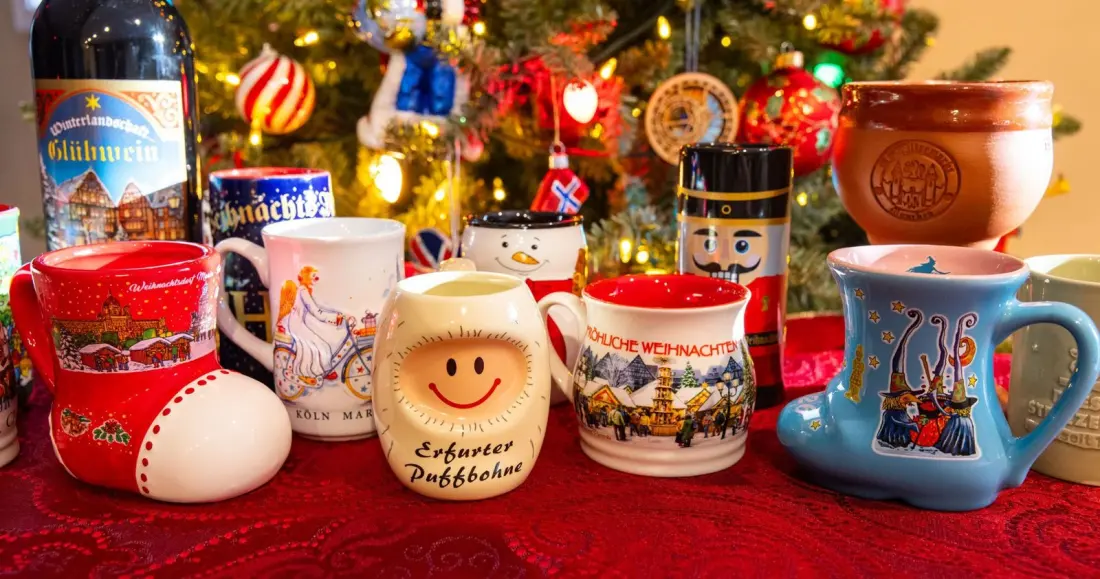
Order a glühwein at almost any European Christmas market and you'll notice the cup isn't a paper one. It's a proper ceramic mug — sometimes boot-shaped, sometimes a hat, sometimes a little bean character with a face — and it's yours to keep, if you want it.
Here's how it works. When you buy a drink (usually €4–6), you pay a deposit called a Pfand on top, typically €2–5. Return the mug and you get the deposit back; keep it and the mug is your souvenir. Some stalls, like Munich's Medieval Christmas Market, charge steep deposits — around €10 for the flaming feuerzangenbowle goblets — but the designs are worth it.
The travel blog Earth Trekkers has spent four Decorners — sorry, four Decembers — working the market circuit through Germany, Austria, the Czech Republic, France, Poland and the UK, and has compiled a rundown of the best mugs in Europe. Their verdict on the standouts:
- **Cutest:** Erfurt, Germany, where the Erfurter Glühweinstübchen stall on Domplatz sells a whole family of Puffbohne mugs — papa, mama and baby — modelled on the broad-bean mascot that locals are nicknamed after.
- **Most unusual shape:** Regensburg's Christkindlmarkt on the main square, which pours glühwein into hat-shaped mugs.
- **Most nostalgic:** Vienna, where boot-shaped mugs appear at several markets, including the Christmas Village on Maria-Theresien-Platz, the Campus of the University of Vienna and Belvedere Palace.
- **Best experience:** Munich's Medieval Christmas Market, where feuerzangenbowle — mulled wine with a rum-soaked sugar cube set alight — arrives in a medieval-style goblet.
- **Favourite traditional:** Esslingen am Neckar near Stuttgart, whose plain green clay mug becomes memorable once filled with flaming feuerzangenbowle.
A few practical notes for collectors. Designs stay largely the same year to year, with just a new date or colour, so you won't miss out by skipping a season. Big markets often have several different mugs — Frankfurt's can have four or five in circulation — so it's worth a lap before you commit. And if you don't want to carry a sticky mug around all day, hand your used one back at the stall and swap it for a clean one. You can also often buy mugs outright without the drink if you've hit your glühwein limit.
Why bother? Because mugs turn out to be cheap, packable souvenirs that keep the trip alive. Come January, they hold your morning coffee and drop you straight back onto a snowy square in Erfurt. And for anyone planning a December trip, they're a fun lens for choosing which markets to see: Munich, Nuremberg, Dresden (home to Germany's oldest market, the Striezelmarkt, dating to 1434), Stuttgart's underrated neighbours Würzburg and Ludwigsburg, and Berlin's 70-plus markets all reward a mug hunter.
If you're mapping a route, the Rhine-and-Bavaria corridor — Cologne, Frankfurt, Nuremberg, Munich — plus a Vienna leg covers the most variety in one trip. Just leave space in your hand luggage for the collection you'll inevitably bring home.