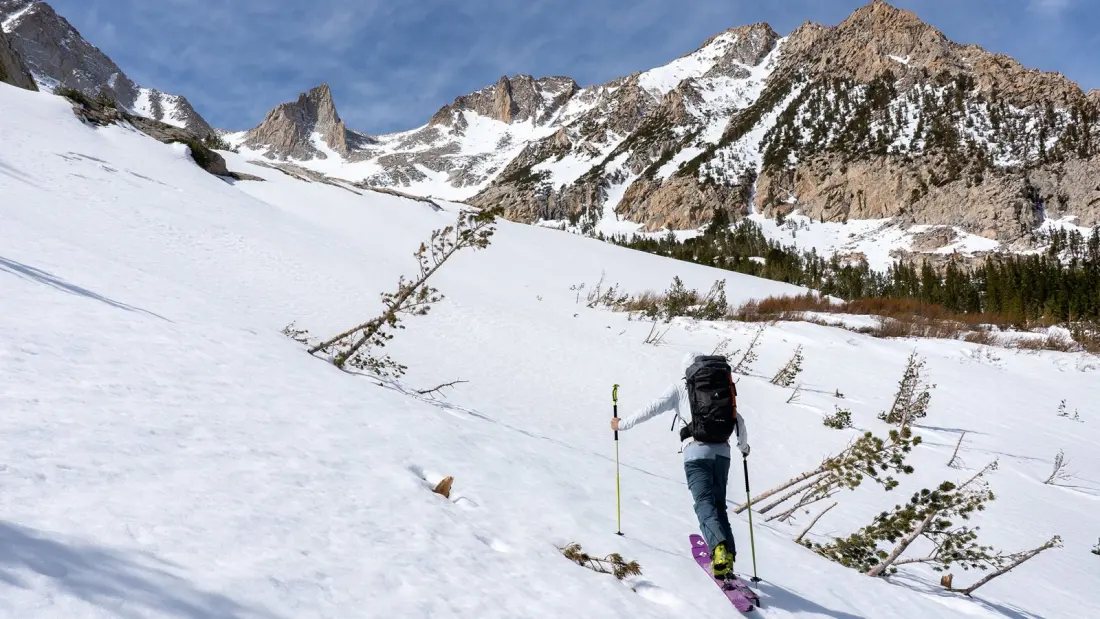
Backcountry skiers used to accept a trade-off: a boot that climbed well skied like a wet noodle, and a boot that ripped on the descent punished you on the skintrack. The latest test of more than 20 alpine touring boots — run by bootfitters, shop staff and freeride athletes across short tours, multi-day traverses and resort laps — found that this season's best models no longer force that choice.
The standouts: Dynafit's Radical Pro took Editors' Choice at $900 and 1,400 grams, thanks to a newly progressive flex that absorbs impacts in rotten snow, a nearly friction-free 60-degree walk mode and a grippy new Vibram sole that held up while downclimbing burnt couloirs in California's Eastern Sierra. The catch is a wide 103.5 mm last that narrow-footed skiers may find sloppy.
Scarpa's all-new Maestrale RS ($899) won best freeride boot. It packs near-alpine power into a four-buckle cabrio design with a Speed Walk 4 mechanism so efficient it out-walks many lighter boots. But the fit is peculiar — tapered toebox, slightly wide heel — so a bootfitter or demo is strongly advised.
Tecnica's Zero G Decoy Pro changed a tester's entire gear philosophy: she stopped believing uphill efficiency required a squirrely descent. Tested in Montana's Beartooths and the French Alps, the $950 boot (or $1,200 in the stiffer 130 flex) felt like an alpine boot in variable spring snow. The price is paid on the climb — its stiffer shell and thick liner make skinning noticeably harder work.
Dalbello's Cabrio LV Free Pro ($930) is the downhill monster, a reborn Lupo with a removable tongue that freeride competitor Josh Bull put through cliff drops in New Zealand without durability worries. At nearly two kilos per boot it's best as a sidecountry boot, and its low-volume fit suits narrow feet with excellent heel hold.
For big days, the Atomic Backland XTD 120 Carbon ($1,150, 1,380 g) offers an unbeatable range of motion and easy transitions, though it's too light to double as a true inbounds boot. And Scarpa's F1 RS ($849, 1,340 g) earns a features nod for being surprisingly strong for its weight, with a walk mode that needs some break-in.
Why it matters: if you're investing in a touring setup this winter, the boot is the piece most likely to make or break the day. The broad takeaway from this year's test is that walking efficiency — smooth pivot, low friction, easy transitions — matters as much as raw weight. Several testers found themselves skinning better in mid-weight 1,400-1,600 g boots than in lighter models, while actually skiing well on the way down. Anyone building a one-quiver setup for both resort and backcountry should look hard at the Decoy Pro or Radical Pro; pure tourers should lean Atomic or Scarpa F1 RS.
Story via Ski Magazine.