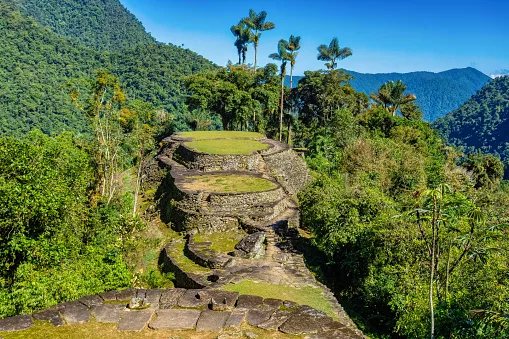
Up a humid mountainside above Colombia's Caribbean coast, roughly 1,200 stone steps lead to a set of terraces most people have never heard of. Ciudad Perdida — the Lost City, known to Indigenous communities as Teyuna — was built by the Tayrona civilisation from around the seventh or eighth century, and reaching it today still takes four days of sweat, mud and river crossings.
The site itself isn't a city of palaces. More than 200 structures — terraces, stone stairways, retaining walls and circular house platforms — were shaped to fit steep hillsides above the Buritaca River, with clever drainage and slope-stabilisation systems. Much of it blends straight into the forest, which is exactly what makes walking through it feel different from your average ruin circuit. Looting led to its wider discovery in 1975, and Colombia's anthropology institute ICANH has run conservation there since 1976.
A crucial thing to understand: this is living Indigenous land. The Kogi, Arhuaco, Wiwa and Kankuamo peoples hold the Sierra Nevada as ancestral territory, and their spiritual practices shape how the site is managed. In a recent example, ICANH closed the park for two weeks in October at the request of traditional authorities so the land could rest. It reopened on 16 October with usual hours of 07:00 to 15:00 — but visitors should expect that temporary closures for cultural reasons can happen again.
The trek typically starts in Santa Marta, with a road transfer to Machete Pelao (also called El Mamey) where the trail begins. Most itineraries run four days return, though three- to six-day options exist. Expect steep climbs, humid heat, muddy paths and river crossings that turn tricky after rain. Nights are spent in basic camps along the route. Independent hiking isn't allowed — a certified guide is required, and authorised operators should be booked in advance. Pack sturdy shoes, a waterproof jacket, insect repellent and a dry bag for electronics.
The reward isn't only the ruins. The trail passes through tropical forest full of birdlife and through rural and Indigenous communities who have farmed these mountains for centuries. Ask before photographing people or homes, listen to your guide, and treat the trek as a chance to support the local cooks, guides and families who make it possible. Fit travellers who want a physically demanding, culturally rich alternative to a beach holiday will find few experiences in South America that compare.