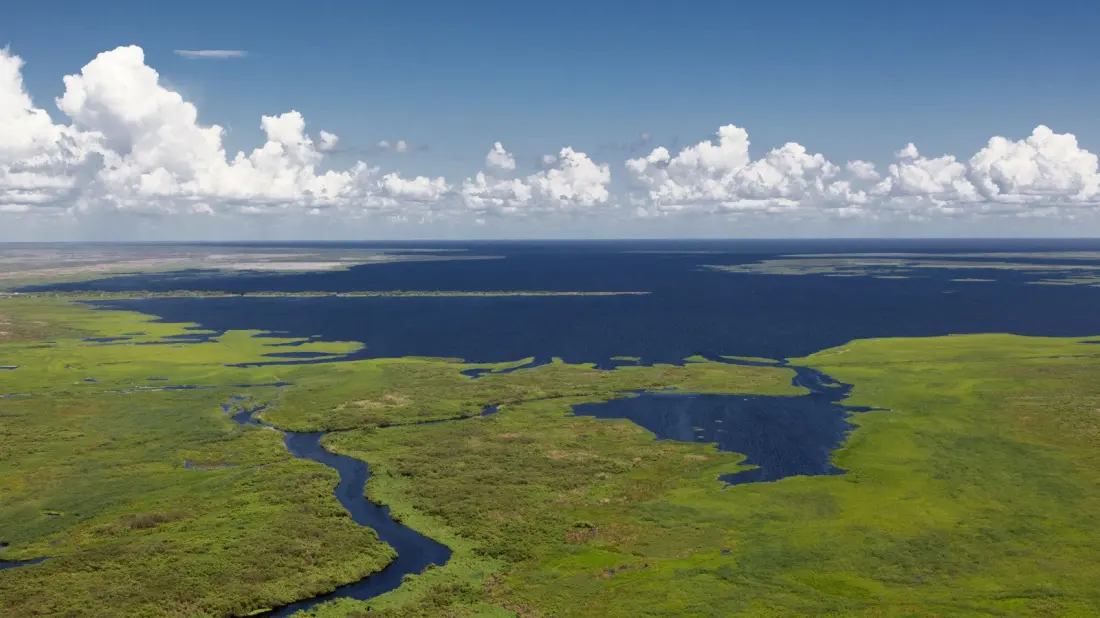
Florida's largest lake is also its most troubled. Lake Okeechobee, a 730-square-mile freshwater giant northwest of Palm Beach, topped a 2025 Lake.com study as the most polluted body of water in North America. Swimming is off the table, and the reasons why say a lot about the state of Florida's water.
The lake is surprisingly shallow for its size — an average of just nine feet deep — which makes it especially vulnerable to runoff. Decades of agricultural fertilizer, sewage and discharges from surrounding farmland have fueled toxic blue-green algae blooms that can cause skin rashes and breathing problems. Recent samples showed lead at 0.67 µg/L, and the lake scored second-worst in the study for turbidity, beaten only by Utah Lake. The nearest town, Clewiston, sits about 65 miles from Palm Beach and has long marketed itself as a bass fishing hub — the fishing remains, but the water is not for swimming.
The pollution doesn't stay put. Okeechobee feeds much of southern Florida's water table, and contaminated water travels out via the Saint Lucie and Caloosahatchee rivers all the way to the coast. That means the problem touches beaches and estuaries far beyond the lake itself.
There's a bit of good news: in the 2026 update of the study, Okeechobee had dropped out of the ten dirtiest lakes entirely. Still, no Florida lake made the top ten cleanest in the U.S., so swimmers heading to the Sunshine State should pick their spots. Ben T. Davis Beach on the Gulf Coast ranks as the state's safest for swimming according to Safe to Swim Florida, while Boynton Beach offers clean Atlantic water not far from the lake. Over in the Panhandle, Jacc Lake in Walton County has strong water quality and clarity.
For something genuinely special, Florida's freshwater springs remain the state's best-kept swimming secret — Crystal River in particular, widely considered the best place in the country to swim alongside manatees. The springs face pressure from development, pollution and climate change, but many are still open and swimmable.
For travellers, the takeaway is simple: Lake Okeechobee is worth visiting for fishing, birdwatching and lakeside trails, but keep your swims for the coast, the springs or a tested inland spot. Florida has no shortage of water; it just pays to know which bits of it are clean.