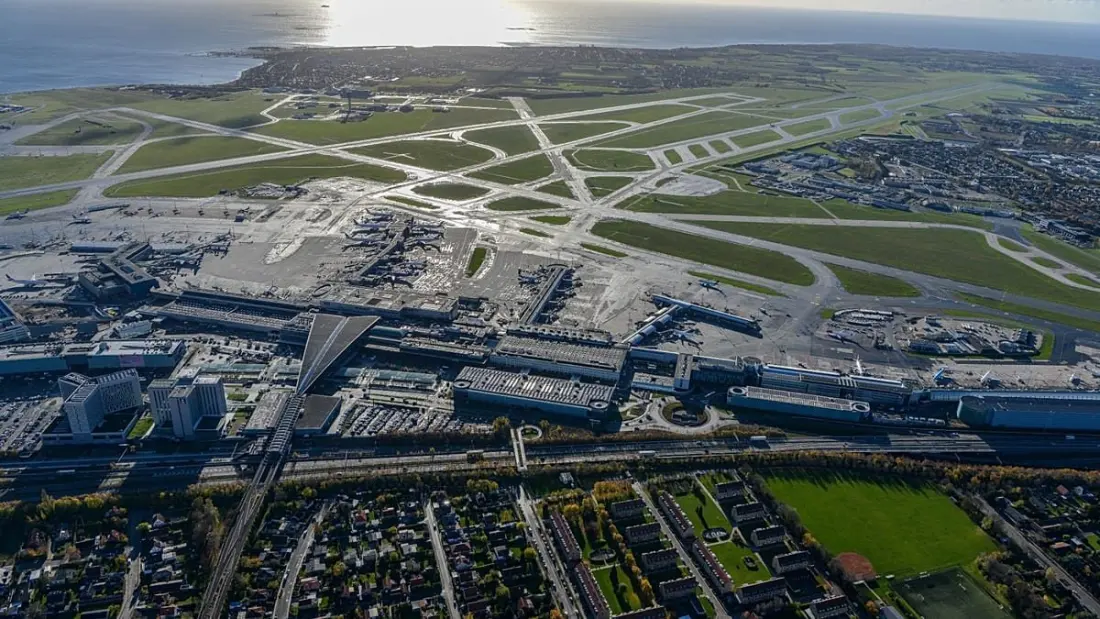
Copenhagen Airport has filed plans to grow from around 34.5 million annual passengers to 55 million — a jump of nearly 60% — in one of the biggest infrastructure projects in Danish aviation history. The Danish Agency for Planning and Rural Development is handling the planning process, with a final planning basis expected by 2028. Only after approval can construction of individual elements begin.
The timing is no accident. The airport handled a record 9.9 million passengers across July, August and September this year, and forecasts 34.5 million travellers for 2026 — 2.1 million more than 2025. Operator Copenhagen Airports A/S is also leaning on IATA projections that global air travel demand will double by 2050.
For travellers, the most concrete changes involve the northwest corner of the airport, which will get stands capable of handling new generations of larger long-haul aircraft. That hints at more direct long-distance routes into Copenhagen. The airport's transverse runway will be relocated and shortened to free up development space. CEO Christian Poulsen framed the expansion as essential for Denmark: as a small, trade-reliant country, its connectivity brings tourists, investment and market access. By 2030, the airport expects the aviation industry to add 35,000 jobs and contribute 60–90 billion Danish kroner (roughly €8–12 billion) to GDP.
There's an environmental side to the story too. Poulsen acknowledged that growth brings noise and emissions, and the plans include raised and expanded noise barriers, noise-absorbing cladding on buildings, and continued taxiway design that keeps ground paths as short as possible while engines are running. Newer aircraft, the operator notes, carry more passengers per movement, are quieter and generally produce less CO2 — so the expansion is partly about making room for cleaner planes.
What does this mean if you're flying in? Right now, not much changes on the ground immediately — the planning work runs to 2028, so the build-out comes later this decade. But if the plans proceed, expect more terminal space, better facilities, and a wider choice of long-haul connections into Scandinavia's busiest hub, which is also the main gateway for visits to Malmö and southern Sweden just across the Øresund bridge. Frequent flyers to Copenhagen may eventually notice a reshaped apron and possibly new intercontinental routes taking advantage of those larger-aircraft stands.
For now, Copenhagen remains one of Europe's more pleasant arrivals: compact terminals, quick trains into the city centre, and a design that hasn't yet been strained by record summer crowds — though those records suggest the breathing room can't come soon enough. Anyone planning a Danish holiday in the next couple of years can book with confidence; the airport works, for now, much as it always has.