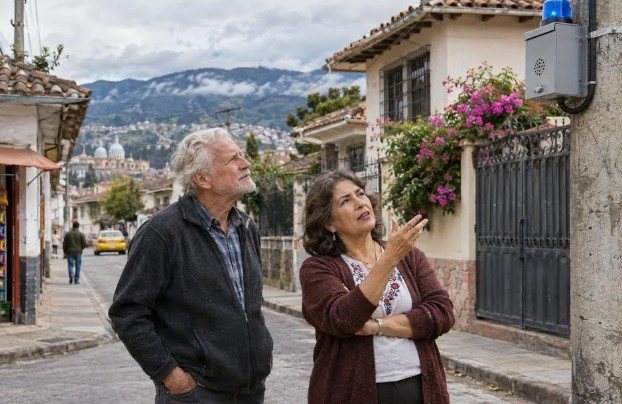
A new community alarm on a concrete pole in a Cuenca barrio sounds like a small municipal story. It isn't. In a widely read narrative from Cuenca High Life, that gray box with its blue strobe light becomes the hinge on which an American retiree's entire relationship with his adopted city turns — and it doubles as a sharp lesson for anyone moving abroad.
The protagonist, David, arrives with a career's worth of organizational expertise and a spreadsheet for everything. When his neighborhood installs a siren to warn of break-ins, fires and medical emergencies, he immediately sees the gap: the hardware works, but there's no plan for who does what. His neighbor Lucía makes the counterpoint that anchors the whole piece — equipment isn't a plan, and a plan isn't something experts impose. It's something neighbors decide together.
What follows is a satisfying study in humility. At a chaotic community meeting behind the church — no agenda, empanadas, a toddler under the refreshment table — David learns to listen instead of manage. His elegant digital database collapses within hours under Lucía's practical questioning: What if the power's out? Who gave permission to collect Doña Mercedes's medical details? Who updates it when you're travelling? The fix is refreshingly analog. A paper map. A printed list of emergency numbers taped beside the shopkeeper's phone. An arrangement where a 78-year-old who refuses to share her health history simply agrees that closed curtains after ten in the morning mean someone should knock.
The story ends with a real dilemma: the neighborhood's first emergency drill is scheduled for the same morning as a flight to Florida, where David's sister has suffered a stroke and he holds her medical power of attorney. Two genuine obligations, one person, no clean answer. It's the moment his two-year expat experiment stops being a lifestyle and becomes a life.
Why should a traveller care? Because Cuenca has one of the largest North American expat communities in Latin America, and the traps David falls into are common ones: importing systems instead of adapting, treating a new home as a project, committing to nothing with a date beyond dinner. The story captures what actual integration looks like — showing up late to a disorganized meeting, being useful rather than in charge, and accepting that a barrio may one day make a claim on you that competes with the life you left behind.
It's also a quietly useful primer on how Ecuadorian neighborhoods organize themselves: community alarms, corner tiendas as informal information hubs, church halls as meeting spaces, and a culture where trust is built door to door rather than through an app. Read it before you rent, and you'll arrive knowing that the question isn't whether the town suits you — it's whether you're prepared to be needed by it.