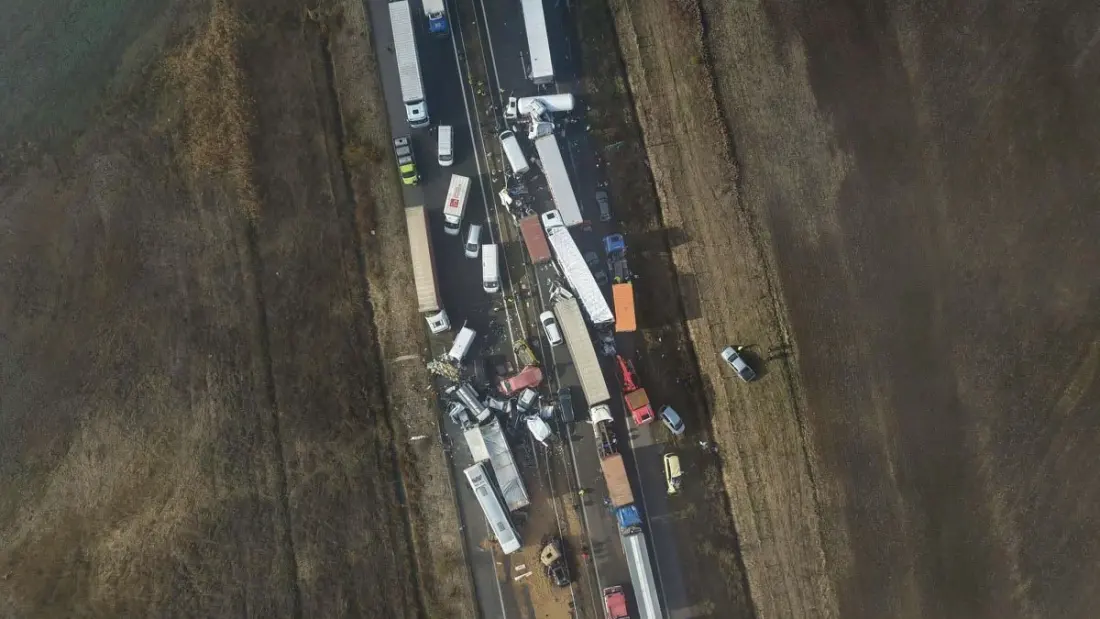
At least 12 people died and dozens more were hurt on Tuesday, 10 November 2026, when dense morning fog triggered two mass crashes on the motorway connecting Sofia with the Black Sea port city of Burgas in southeastern Bulgaria.
The pileups happened around 7 a.m. on opposite carriageways at the same spot. Roughly 86 vehicles were involved, many of them heavy trucks. Health Minister Katya Ivkova said 10 people died at the scene and two more succumbed to their injuries en route to hospital, while 46 others were taken to medical facilities. The road was closed in both directions as emergency crews worked the site.
Regional Governor Mihail Kasherov, speaking from the scene, said he had never seen anything like it. Police opened an investigation and gave an early read on the cause: sudden, fast-forming fog cutting visibility to near zero, a wet road surface, and speeds simply too high for the conditions.
The disaster rattled the country's political schedule, too. European Commission President Ursula von der Leyen was on a working visit to Bulgaria that day, and Prime Minister Rumen Radev left her side to travel to the crash site, forcing a reshuffle of her itinerary. President Iliana Yotova cut short her attendance at the Paris Peace Forum to fly home.
For anyone planning a road trip in Bulgaria — and plenty of travellers rent cars to reach the Black Sea coast or the mountains — this is a sobering reminder of how quickly conditions can turn on the country's main arterial routes. The Sofia–Burgas motorway is the primary corridor from the capital to the southern Black Sea resorts around Sunny Beach, Burgas and Sozopol, so it sees heavy summer traffic. Fog is a real hazard outside peak season, especially on autumn and winter mornings near low-lying and river stretches of the route, and wet tarmac after rain makes stopping distances dramatically longer.
The practical takeaway is simple: check the morning forecast before setting out, slow well below the limit when visibility drops, keep headlights on (Bulgaria requires dipped beams at all times outside built-up areas), and leave far more distance to the vehicle ahead than feels necessary — especially when trucks are in the mix. If fog rolls in fast, the safest move is often to pull off at the next services and wait it out rather than press on.
Our thoughts are with everyone affected by the crash and the emergency teams responding to it.