
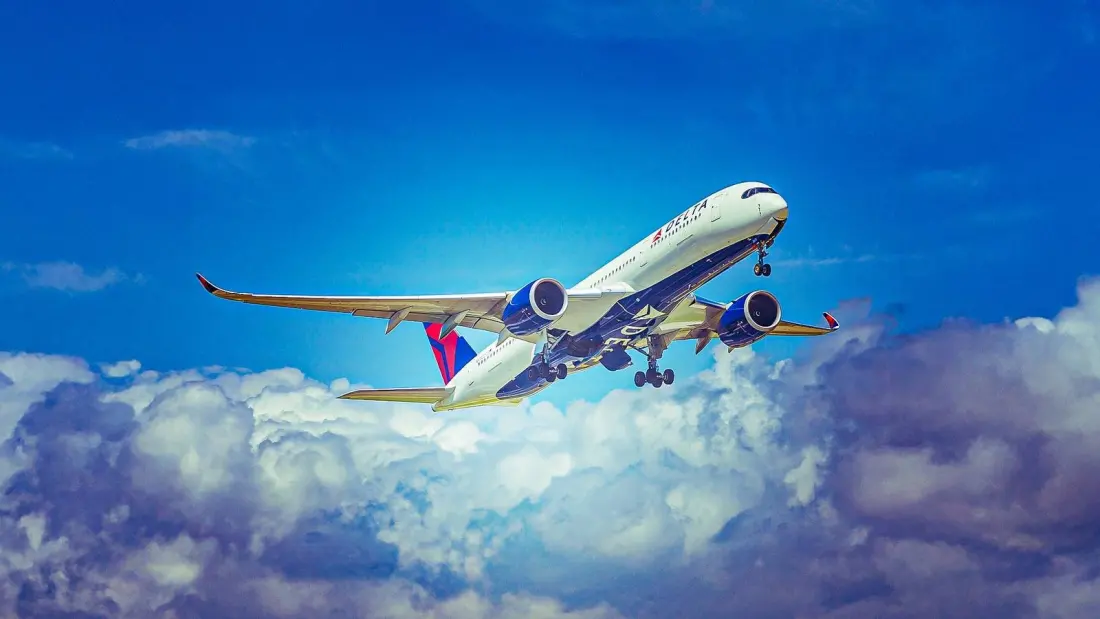
If you've ever tried to answer emails at 35,000 feet only to watch a page spin forever, help may be on the way — at least if you're flying Delta across the Americas or the Pacific. Viasat, the satellite company that powers Delta's inflight WiFi, has switched on a new satellite that expands capacity over the Americas and, importantly for long-haul flyers, pushes coverage west across much of the Pacific Ocean.
The satellite, dubbed VS3 F2, entered service recently and forms part of Viasat's flagship VS3 constellation. The company's chief executive Mark Dankberg has described the series as the most advanced commercial satellites in the world when it comes to adaptive beam forming, and says the constellation is now fully operational. A companion satellite, VS3 F3, already went live over Asia-Pacific back in August — and that combination is what makes this genuinely useful for travellers rather than just a footnote in a press release.
Here's the practical bit: as a Delta aircraft flies west on a transpacific route, it moves out of the F2 satellite's footprint and straight into the F3's. That handover means passengers on routes to Asia should get a faster, more consistent connection for the whole flight instead of losing coverage mid-ocean. For anyone who has attempted a video call from a plane over the Pacific, that's a real upgrade. Expected upload speeds of around 100 MB per second have been flagged, though aviation watchers caution that the improved service won't appear on Delta aircraft overnight — the technology needs to be activated on the fleet, which is expected to happen soon rather than immediately.
There's a wrinkle in the timeline. Delta has already announced its next-generation WiFi partner: Amazon Leo, which will begin installing on around 500 Delta aircraft from 2028 as part of the airline's Delta Sync connected-cabin experience. So the Viasat boost is a near-term improvement rather than a permanent arrangement. The choice of Amazon over SpaceX's Starlink stirred up some drama, with Elon Musk claiming travellers are avoiding Delta because it lacks Starlink — a claim based on a handful of social media posts rather than hard data.
Why does this matter if you're planning a trip? Inflight WiFi has shifted from a perk to a baseline expectation, especially for anyone working en route or on long-haul flights where staying connected is the whole point of paying for the service. If you're booking a Delta transpacific fare in the coming months — think Los Angeles or Seattle to Tokyo, or US East Coast connections through to Sydney — the connectivity experience should quietly improve even before the Amazon Leo rollout begins. For remote workers and digital nomads, it may make Delta a more defensible pick on routes where several carriers compete. Just keep expectations calibrated: the satellite is live, the fleet upgrade is imminent but not instant, and the real overhaul arrives with Amazon's hardware from 2028.