
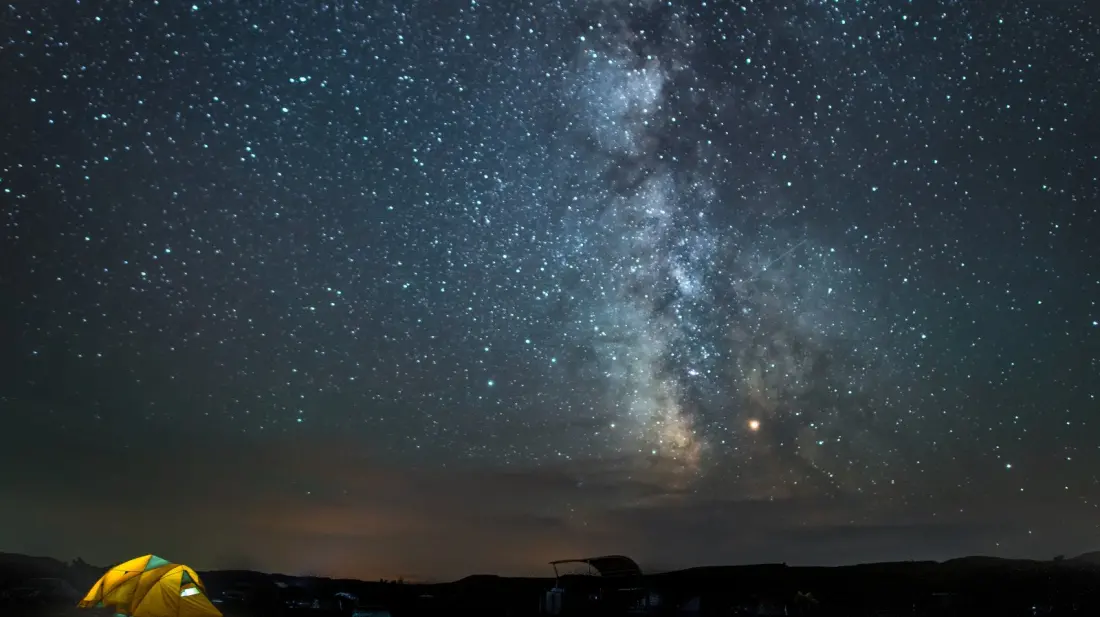
When night skies are brightening by roughly 10% a year, genuinely dark corners of the country are worth seeking out. A recent study by Live Casinos scored every US state out of 10 on star visibility, based on average cloud cover and Bortle Scale ratings — the scale astronomers use to measure sky darkness. The winner wasn't a desert giant like Arizona or Texas. It was South Dakota, with a score of 7.79.
The state's secret is a simple combination: very few people and very few clouds. Average cloud cover sits at just 11.65%, and more than half of South Dakota's territory falls within Bortle Scale 1 to 3 — dark enough to see the Milky Way and even comets with the naked eye. Wyoming (7.65), Alaska (7.64), Montana (7.51) and Arizona (7.37) round out the top five, but South Dakota takes the crown.
So where should you point your tripod? The study singles out Sanborn County in the east-central part of the state, which scored 8.78 — the highest of any county in America — and sits within easy driving distance of Sioux Falls, home to the state's largest airport. Head southwest instead and you'll hit the Black Hills National Forest, a 1.2-million-acre pine wilderness with a perfect Bortle 1 rating, reserved for the darkest skies on Earth. You can book a developed campground or go fully off-grid with dispersed backcountry camping.
Badlands National Park is nearby, and it's a stargazing double act: surreal erased-rock formations by day, a full celestial theatre by night. The park has earned International Dark Sky Park status, and in summer it runs guided Night Sky Viewings daily. Prefer solitude? Overnight visitors recommend the northeast entrance parking area or the Hay Butte and Sage Creek overlooks, which tend to be empty after dark.
If you'd rather dodge the crowds entirely, quieter options include Sica Hollow State Park and Snake Creek Recreation Area, which clocks in at a Bortle 2. Whoever you are — first-time sky-watcher or serious astro-photographer — the state's low visitor numbers mean you'll rarely share your patch of darkness with anyone else.
A little prep goes a long way. Time your trip around a new moon (or the days just before it) for the fullest view of stars, planets and the Milky Way. Bring binoculars or a telescope if you want to pick out deep-sky objects, pack warm layers because prairie nights get chilly even in summer, and don't skimp on bug spray — mosquitoes love the wilderness as much as stargazers do.
Why it matters: dark-sky trips are one of travel's fastest-growing niches, and South Dakota offers world-class darkness without the crowds or the price tag of better-known western parks. It's also one of America's least-visited states, so even in peak season you'll find room to spread out under the stars.