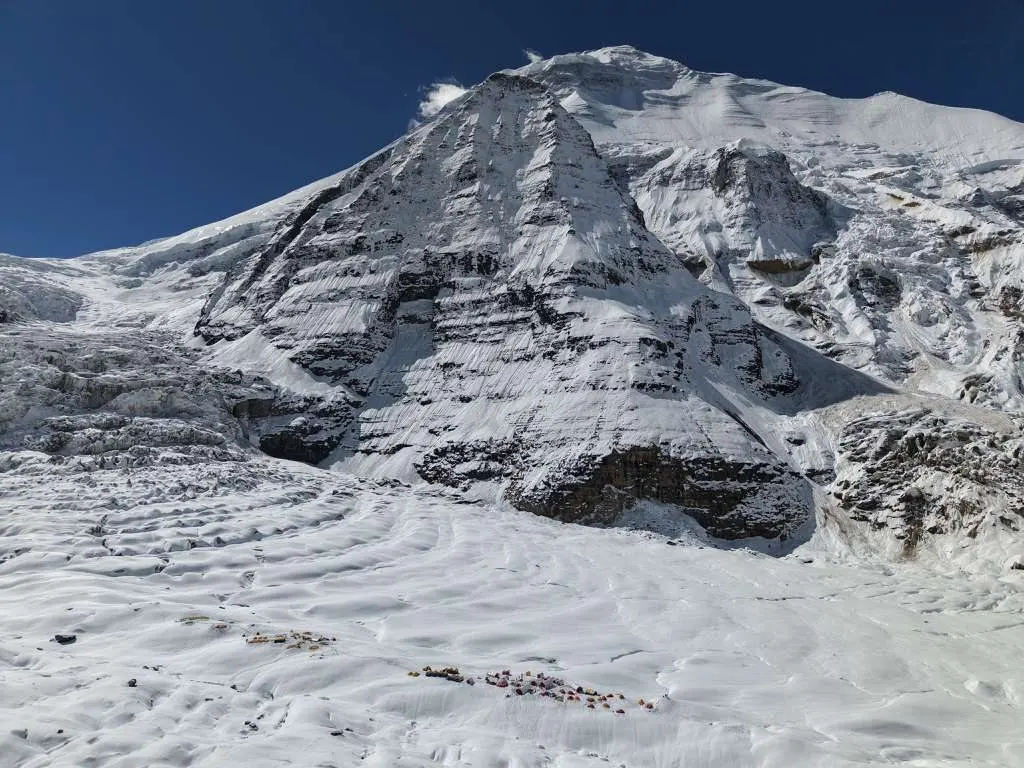
Dhaulagiri has joined Manaslu as the second 8,000-metre peak of the autumn season to finish with zero summits, and the exit has been anything but quiet. When the rope-fixing team working for Seven Summit Treks stopped above Camp 3, all 20 climbers waiting at Camp 2 were ordered back to Base Camp — including clients from smaller outfitters who had never been consulted about the decision.
Australian climber Paul Clarke, who had waited five days at Camp 2 with 8K Expeditions, told ExplorersWeb the mood on the mountain turned uncomfortable once Makalu Lakpa Sherpa, leader of the 14 Peaks Dhaulagiri Expedition, descended after calling off his VIP clients' summit bid. A helicopter was waiting for those clients at Base Camp, and other teams' expeditions were effectively over with it.
Makalu Lakpa's version is straightforward: winds picked up on October 10, raising slab-avalanche risk for the planned October 11 push, so his team turned around. He pointedly added that he is not responsible for other teams' ambitions or rope-fixing arrangements, and pushed back at critics on social media. Seven Summit Treks' Chhang Dawa Sherpa argued the weather window was simply too short for a multi-day summit rotation.
Not everyone buys it. Clarke and Vincere Zeng of Singapore — a seven-time 8,000er climber — both say the winds of October 10 were forecast days in advance, and that October 11-12 looked usable, with the next serious wind cycle not due until October 14. Zeng's team had deliberately waited at Camp 2 through the windiest days, planning a summit attempt on the 12th with buffer days built in. Instead, the expedition was called off before conditions could be reassessed. Sherpas sent up by 8K to retrieve gear from Camp 3 at 7,100m reported good conditions to that point, though nobody could verify what the summit slopes looked like.
The deeper frustration is structural. Smaller teams are dependent on whatever rope-fixing agreements exist between the big operators, and clients have no visibility into those deals. When the main fixing effort stops, everyone stops — regardless of their own weather reading or willingness to turn around if it proved unsafe. Clarke and his climbing partner Xenia Santha say speaking to the press has drawn tension, with Santha receiving a message questioning why they'd gone public.
Nearly all teams have now packed up Base Camp and flown out by helicopter. The one holdout is Polish ski-mountaineer Andrzej Bargiel, who remains with a large support and film crew hoping to summit and ski down. If he makes it, climbers note, his descent will offer a telling data point on what the conditions actually were.
For anyone eyeing a commercial 8,000er, this is a useful case study: ask your outfitter upfront who fixes the route, who decides when the mountain closes, and what happens to your money and schedule if a lead operator pulls the plug. On Dhaulagiri this autumn, that decision belonged to one team — and it ended the season for everyone.