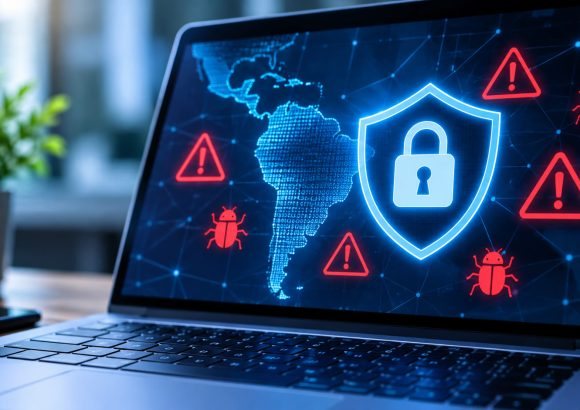
The Dominican Republic now sits near the top of the Caribbean and Central American cybersecurity risk table. According to Kaspersky's Threat Landscape for Latin America report, the country recorded 4.2 million blocked malware infection attempts between September 2025 and September 2026 — more than any of its regional peers.
The wider numbers put things in context. Costa Rica logged 3.6 million blocked attempts, Guatemala 3.4 million, Panama 3.3 million and El Salvador 1.2 million, bringing the five-country total to roughly 15.7 million. Across Latin America as a whole, Kaspersky blocked 592 million attempts, an 18% drop on the previous period. Fewer attacks overall, yes — but the firm warns the nature of the threat is changing, with cybercriminals shifting from mass campaigns to targeted operations against specific sectors, particularly government and manufacturing.
Government institutions were the single most targeted sector in the region, absorbing 27.3% of blocked attempts. Process manufacturing followed at 12.5%, retail and wholesale trade at 11.5%, and healthcare at 8.3%. Windows devices remain the prime target, and Kaspersky researcher Fabio Assolini flagged software piracy tools as a particular regional risk — including cracked license activators that ask users to switch off their antivirus before installing. That move can expose devices to spyware designed to lift passwords and other sensitive data. Adware, too, can slow devices down, hijack browsing and open doors to financial fraud.
So why should a holidaymaker care? For most visitors, the DR remains a straightforward, well-trodden destination — but this report is a useful prompt to treat your devices as carefully as your passport. That means skipping pirated software downloads entirely, being cautious with unknown USB drives or install prompts, using updated security software rather than disabling it, and leaning on a VPN rather than trusting hotel or café Wi-Fi with sensitive logins. If you're working remotely from a beachfront co-working spot in Santo Domingo or Las Terrenas, the basics matter even more.
For travel businesses operating in the country — hotels, tour operators, agencies handling guest data — the report is a sharper warning. With government systems the region's top target and attackers now picking their victims deliberately, weak device hygiene can become a data breach with guests' payment and identity details attached.
The takeaway is simple: the Dominican Republic's cyber risk profile is one of the highest in the Caribbean basin, but the main dangers are avoidable with common sense. Update your devices, avoid anything offering a free crack of paid software, and keep two-factor authentication switched on. That covers the bulk of what these millions of attempts rely on.
Dominican Today