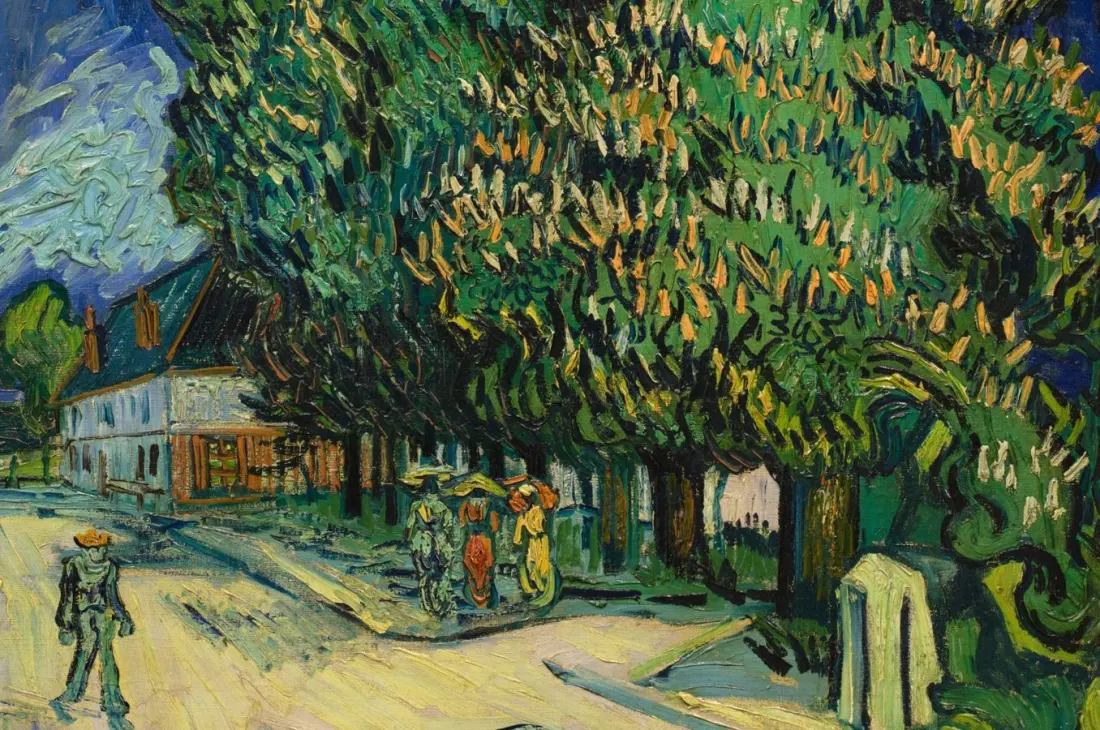
A painting Vincent van Gogh made in the final weeks of his life has just become the most expensive work by the artist ever sold at auction. Châtaigniers en fleurs (Chestnut Trees in Blossom), painted in May 1890 in Auvers-sur-Oise, France, fetched US$190.43 million at Sotheby's in New York on November 18, 2026. That's the fourth-highest price any painting has ever achieved at public auction.
The sale closed a remarkable chapter in the painting's history. It had spent half a century in Argentina, acquired in 1975 by collectors Nelly Arrieta de Blaquier and her husband Carlos Pedro Blaquier through the Wildenstein dealership, and kept largely out of public view ever since. Before the auction there was another complication: the heirs of Samuel Fischer, the Hungarian-born Jewish publisher who sold the work in 1936, argued the transaction happened under duress during Nazi persecution. Sotheby's announced a settlement between the Blaquier family and Fischer's descendants the day before the sale, clearing the way for bidding.
And the bidding was brisk. Estimated at US$180 million, the painting opened at US$135 million and hammered at US$165 million after several minutes, finishing at US$190.43 million with fees. That smashed van Gogh's previous auction record of US$117.2 million, set in 2022 by Orchard with Cypresses, by more than US$73 million.
The van Gogh anchored a bigger event: Sotheby's evening sale of twelve paintings from the Blaquier-Arrieta collection, assembled from the 1960s onwards and totalling US$411.98 million. A Cézanne portrait of his son Paul in Harlequin costume, Arlequin, brought US$111.01 million, though it fell short of its US$120-150 million estimate. The rest of the collection read like a roll call of Impressionism and early modernism — Monet, Renoir, Degas, Pissarro, Gauguin, Sisley, Toulouse-Lautrec, Derain and Vlaminck. Every lot sold, but six went below their low estimates, and the top two paintings accounted for roughly three-quarters of the total.
For context, the all-time auction ranking now reads: Leonardo da Vinci's Salvator Mundi at US$450.3 million (2017), Klimt's Portrait of Elisabeth Lederer at US$236.4 million (2025), Warhol's Shot Sage Blue Marilyn at US$195 million (2022), then the van Gogh, with Pollock's Number 7A, 1948 at US$181.2 million slipping to fifth.
Why does this matter beyond the saleroom? Collections like this rarely surface. Works hidden in private hands for decades occasionally reappear in museum exhibitions or travelling shows, and the dispersal of the Blaquier-Arrieta collection may put these paintings back in front of the public — possibly in new institutional homes around the world. For culture-minded travellers, it's a reminder that the paintings you plan a trip around — a van Gogh pilgrimage to Auvers-sur-Oise, a Cézanne hunt in Aix-en-Provence — come from collections like this one, and where they hang next can reshape an art-lover's itinerary.