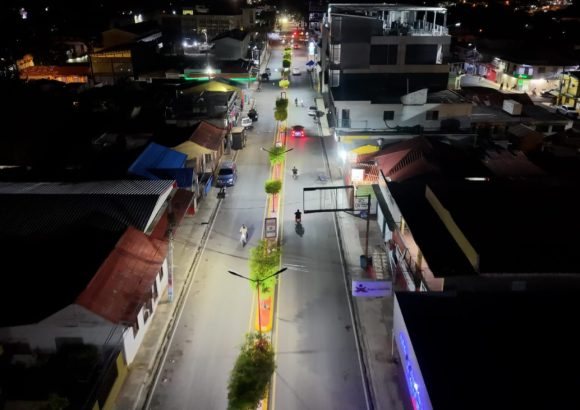
The Dominican Republic is rolling out a major upgrade to its electricity grid, and the country's tourism-heavy north coast stands to benefit most. Energy and Mines Minister Joel Santos announced that 68,501 new streetlights will be installed across seven northern provinces between 2027 and 2028, part of a national programme totalling roughly 251,000 lights.
The distribution tells you where the action is. Santiago, the inland hub of the Cibao region, gets the biggest share at 32,798 lights. Puerto Plata, a classic beach destination, follows with 13,512, then La Vega with 10,455. Smaller allocations go to María Trinidad Sánchez (4,072), Monte Cristi (3,866), Samaná (1,973) and Monseñor Nouel (1,825). That last batch includes Samaná, the whale-watching peninsula, and Puerto Plata, both places where visitors are often out after dark heading to and from dinner or the malecón.
The streetlights are only one slice of a larger investment. The government expects to put US$750 million into electricity distribution during 2027 and 2028. That covers rehabilitating around 1,800 kilometres of power networks, upgrading 18 substations, and buying new meters and transformers, plus expanded remote monitoring of consumption — the unglamorous plumbing that decides whether your hotel's air conditioning cuts out during a storm.
There's a storage target too: at least 800 megawatts of battery capacity by 2028, aimed at keeping supply stable during peak evening demand. And a new 345-kilovolt transmission line will link Manzanillo in Monte Cristi province with El Naranjo in Santiago via Guayubín, allowing power from new generation projects in Manzanillo to reach the national grid.
For travellers, why does this matter? Anyone who has spent time outside the Dominican Republic's resort zones knows that blackouts and dimly lit streets are a real feature of the experience, especially in smaller towns. Better lighting in places like Puerto Plata and Samaná should mean more comfortable evening strolls, safer arrival after late flights, and a general lift for the local restaurants and bars that depend on evening foot traffic. It's also a sign the country is investing in the regions tourists actually visit, not just Punta Cana in the east.
Who's this for? Independent travellers heading to the north coast — Puerto Plata's beaches, Samaná's humpback whale season, or the mountains around Jarabacoa and La Vega — rather than those sticking to gated all-inclusives. If you're planning a trip in 2027 or 2028, you may well notice the difference as the work lands.
Story first reported by Dominican Today.