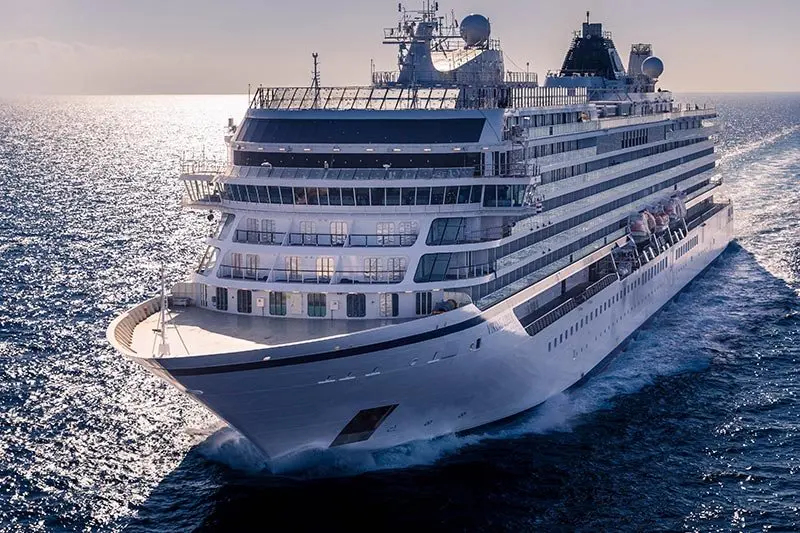
Viking has taken delivery of the Viking Libra, a 998-guest ocean ship handed over at Fincantieri's yard in Ancona, Italy. She'll spend her first season sailing the Mediterranean and Northern Europe — and she arrives with a distinction none of her fleetmates can claim: a hybrid propulsion system built to run on liquefied hydrogen and fuel cells.
On paper the Libra looks familiar. She's a sister to the rest of Viking's ocean fleet, so returning guests can expect the same pared-back Scandinavian style, small-ship scale and adults-only atmosphere the line is known for. Under the deck, though, things change. The hydrogen-ready setup makes her one of the first mainstream cruise ships designed around fuel-cell technology rather than conventional fuel alone.
She won't be alone for long. The Viking Astrea, already under construction, will carry the identical system, and Viking expects both ships to actually be operating on hydrogen from 2027. Viking president and CEO Leah Talactac called the delivery a milestone for the growing fleet, framing the two ships as a new standard for innovation rather than a one-off experiment.
The delivery also slots into an unusually ambitious build programme. Viking plans to take 25 more river ships by 2030, 10 more ocean ships by 2032 and two more expedition ships by 2031 — numbers that would take the company to 123 river ships by 2030 and 28 ocean and expedition vessels by 2032.
For travellers, the practical upshot is choice. Viking's ocean product keeps expanding on classic itineraries — the Med in summer, Northern Europe and the Baltic — while the fleet gradually gets cleaner. If low-emission cruising matters to how you travel, the Libra and Astrea are the two ships to watch over the next couple of years, with hydrogen operation expected once they're in service in 2027.