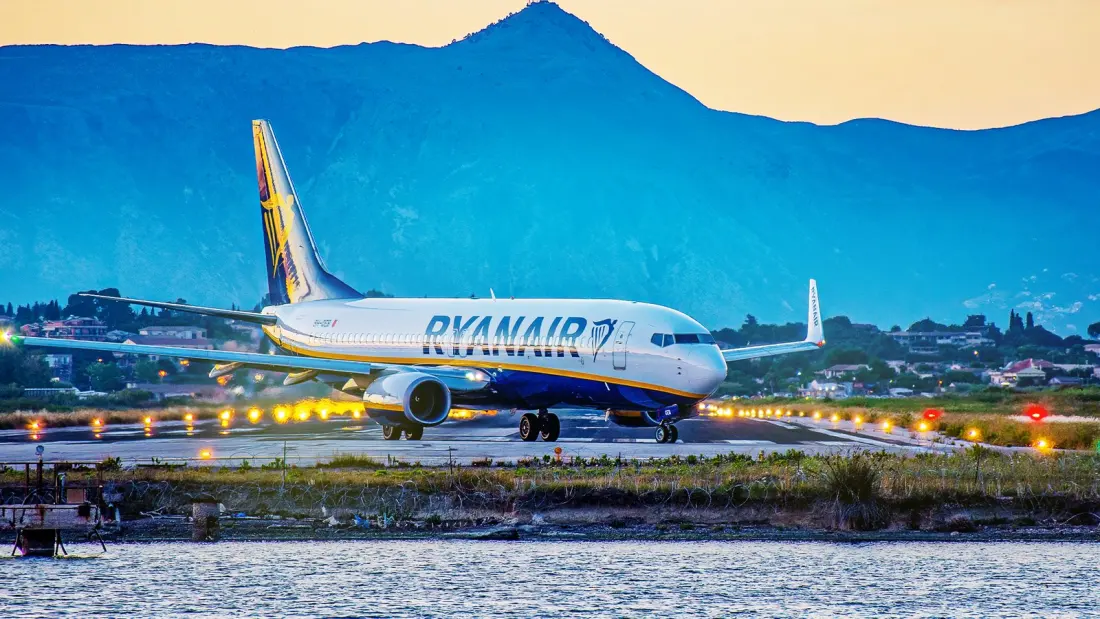
One Boeing 737-800 can fly eight revenue sectors in a single day. Ryanair's Malta Air-registered 9H-QEB did exactly that on October 12, hopping between Sicily, Albania, mainland Italy, France and Sardinia in a schedule that shows why ultra-low-cost carriers are so hard to beat on price.
The day starts brutally early. From Catania in Sicily, the aircraft departs at 04:27 UTC for Tirana, Albania, landing just over an hour later, then immediately turns around and flies back. By 11:52 UTC it has already completed four flights: the two Albanian sectors plus a Catania-Bologna round trip. The afternoon brings the longest legs of the day, a 2 hour 45 minute hop to Paris Beauvais and back, logging over ten hours of airborne time in total. The final flights are short evening dashes to Cagliari in Sardinia and back, with the aircraft parking up at Catania shortly after 22:25 UTC.
The secret is the turnaround. Legacy airlines typically budget 50 to 70 minutes to turn a narrowbody around, while low-cost operators enforce a rigid 25-minute window. Passengers deplane via forward and rear airstairs rather than jet bridges, cabin crews sweep the rows quickly, and fuel and baggage teams work the tarmac simultaneously. Dispatchers also build some buffer into the roster, so minor air traffic delays don't cascade into the evening flights.
There's another less obvious ingredient: total fleet uniformity. Because Ryanair runs an all-737 fleet, engineers at every base face no unfamiliar avionics or engine configurations, keep identical spare parts and tooling, and clear overnight checks fast enough to guarantee the next dawn departure. Legacy carriers, by contrast, often fly only three or four sectors per airframe daily and route everything through expensive hub airports.
High utilization is what makes €20 fares mathematically possible. Every extra flight spreads fixed costs such as leases, insurance and ownership across more passenger kilometres, driving unit costs down. The trade-off is fragility: with minimal spare aircraft and tight margins, one weather disruption or strike can ripple through an entire evening's schedule, whereas network carriers can simply swap in a standby plane.
For travellers, this is why Ryanair works the way it does: secondary airports like Beauvais, early departures and quick turnarounds aren't quirks, they're the business model that keeps fares low. If your flight is on time, thank a 25-minute turnaround.