Most Salvadoran churches look a certain way — and that's exactly what makes El Rosario stand out. Sitting on the east side of Plaza Libertad in downtown San Salvador, this active Catholic church swaps the usual colonial playbook for a sweeping reinforced-concrete arch and ribbons of coloured glass. It might be the most striking 15 minutes you'll spend in the capital.
The building has a proper backstory. The site once held San Salvador's first cathedral, and it's identified by the Ministry of Culture as the burial place of José Matías Delgado, the priest who helped lead Central America's independence movement. After a wooden predecessor burned down, Dominican friars Alejandro Peinador and Domingo Iturgaiz commissioned artist Rubén Martínez Bulnes in 1962 to design something new. His plans were so unconventional that local church authorities balked — it took Vatican approval to move forward. Construction ran from 1964 to 1971, the site was declared historic in 1972, and the church itself was recognised as a cultural asset in 2015.
Inside, the design makes sense immediately. The arch spans the whole worship space with no interior columns, so there's an unobstructed view of the altar from every seat. Rectangular stained-glass panes sit in concrete frames along the curved roofline, and on sunny days they throw bands of rainbow colour across the altar, metal and rock walls. Martínez also shaped the Stations of the Cross from angular, rough-surfaced metal — worth a closer look once your eyes adjust to the dim interior.
Timing is everything here. Come early morning or late afternoon on a clear day, when the light through the glass is at its most dramatic. Sit down for a few minutes rather than photographing and leaving; the colours shift as clouds pass, and a change of seat changes the view.
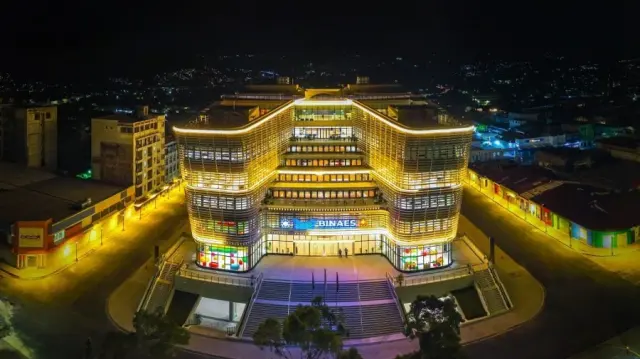
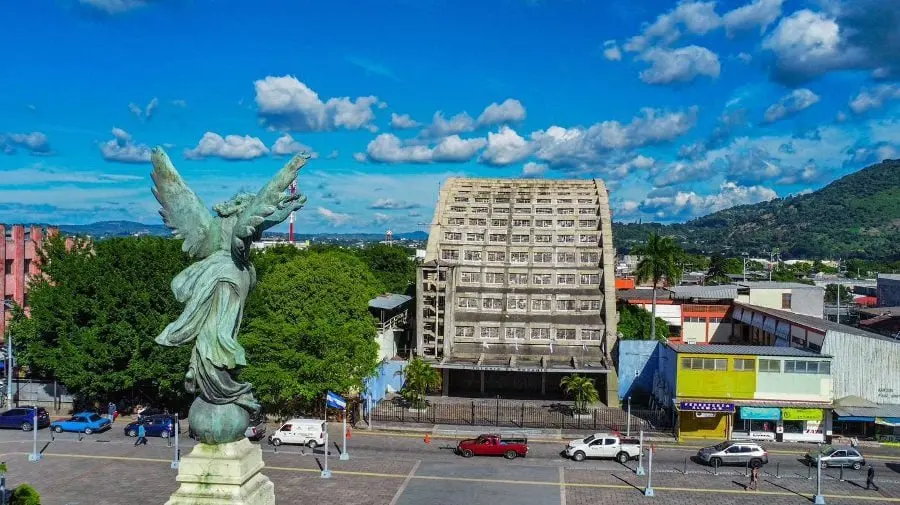
El Rosario also anchors a solid downtown walking route. Start in Plaza Libertad, where a monument commemorates Central American independence and you can take in the church's curved roof from outside. Then walk west to Plaza Gerardo Barrios for the Metropolitan Cathedral and the National Palace, with the glass-fronted National Library (BINAES) also facing the square. It's a short loop past some of the capital's most recognisable buildings, spanning several eras of architecture in one walk.
A few practical notes: it's still a working church, so check visiting hours and Mass times before heading downtown, keep your voice low, and ask before photographing inside. Entry is quick and free-flowing — this is a drop-in sight, not a guided-tour operation — which makes it easy to slot into any San Salvador itinerary.
For travellers, the appeal is simple: it's a genuinely unusual building in a capital most visitors rush through en route to surf beaches and volcanoes. If you're spending a day in San Salvador, give El Rosario a slot on your downtown walk — see it from Plaza Libertad first, then step inside and wait for the light to do its thing.