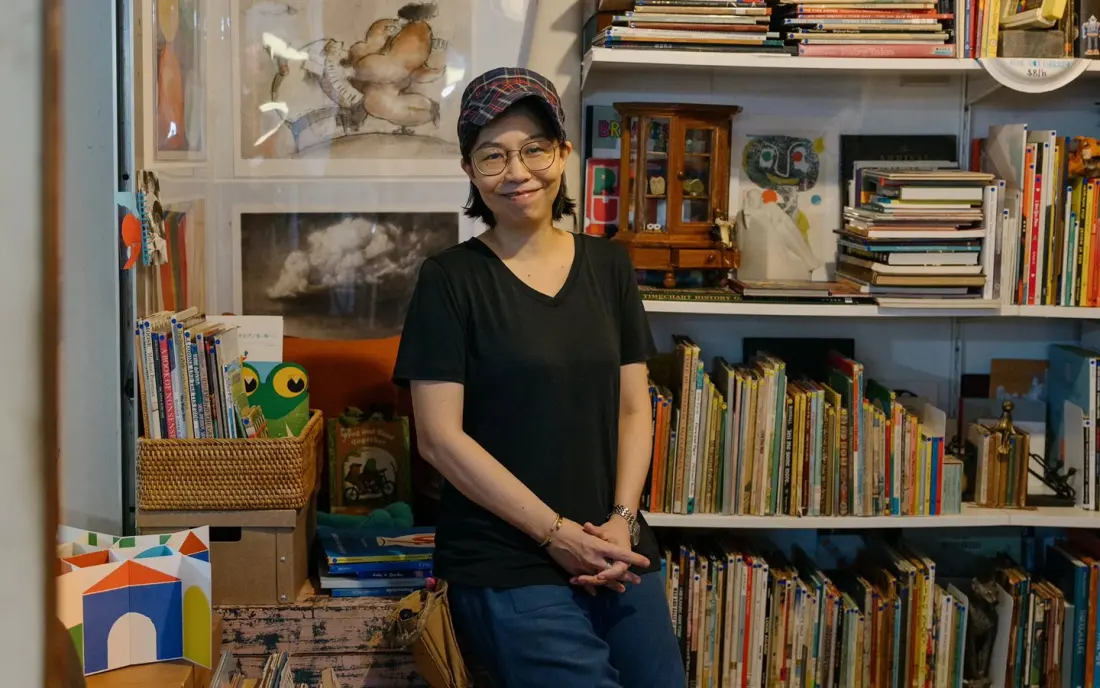
Inside Chinatown Complex — the sprawling, well-worn hawker centre and market in the heart of Singapore's Chinatown — most stalls sell clothing, souvenirs, jewellery and religious artefacts. Then there's stall on the ground floor housing Eliko Picture Books & Collectibles: a 65 sq ft independent library where $8 buys you a coffee and a seat with vintage picture books.
Eliko is a one-woman project. May Lin Au Yong, 48, a part-time documentary-making lecturer and former business journalist, opens at 9am with an hour of hauling furniture out of the tiny unit, then reverses the process when she closes at 4.30pm. She named the shop after her nephew Eli and her brothers, and started it in 2021 at Pearl's Hill Terrace before relocating to Chinatown Complex in April 2025.
Her love of picture books came late. It wasn't childhood nostalgia — she grew up on Enid Blyton and Roald Dahl — but two books she encountered during her master's in 2008: Olivier Dunrea's Ollie the Stomper and Shaun Tan's wordless migrant story The Arrival. That afternoon convinced her picture books aren't just for kids, and she began collecting. By the time Eliko opened she had around 50 titles; the collection now runs to roughly 600 books, many sourced on her travels — recently 140 titles from Japan in five bags totalling 80kg, hauled up to a lift-less hostel.
The model borrows from Singapore's comic cafés: pay to read on site. The $8 fee covers browsing with coffee. A handful of books are for sale, mostly $25-$30 with older titles up to $100. The crown jewel is a Beatrix Potter series printed in 1905. Her personal favourites — a Katsumi Komagata pop-up and The Arrival — aren't for sale, though she admits she may eventually trade them for shelf space.
Eliko costs about $1,000 a month to run, on top of some $15,000 invested in the collection. It's funded by a lifestyle sacrifice: May Lin moved back into her parents' place, sleeping in the storeroom, precisely because she has no room for books at home. Profit clearly isn't the point — she describes bookselling as an "existential" business — but seeing people enjoy the space makes it worthwhile.
For travellers, this is a properly offbeat Singapore stop: half an hour between hawker lunches, browsing decades-old printing where the ink and paper quality show their age in the best way. It pairs naturally with Chinatown Complex's famous food stalls, and it's a reminder that the city's most interesting shops often hide in the least expected corners — May Lin herself says a "natural fit" would have been Joo Chiat, Katong or Tiong Bahru, which is exactly why Chinatown feels like a find.