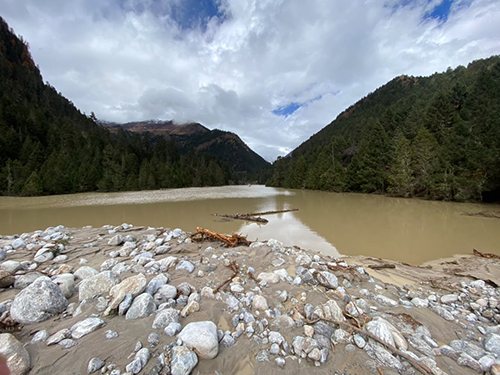
A landslide dammed lake high in Bhutan's Gasa district is being watched around the clock after a glacier lake outburst flood (GLOF) on 29 October 2026 sent water surging down the Mochhu river system. For now, the news is reassuring: an artificial lake that formed at Taktsemakhang, where the Shintaphu Chhu meets the Lungu Chhu, is stable, with no rise in water level and a constant outflow.
The story began at Shintaphu Tsho, a glacial lake below Wakila Mountain in Laya Gewog. NCHM records had flagged it as one of the country's riskier GLOF lakes — an estimated 6.2 million cubic metres of water, roughly 2,480 Olympic swimming pools, spread across about 59 acres. When it burst, floodwater cascaded through Taktsemakhang around 8:27 pm, sirens sounded along the Mochhu and downstream Punatsangchhu, and evacuations were ordered for vulnerable settlements across Gasa, Punakha, Wangdue, Tsirang and Dagana.
The flood's debris blocked the outlet of the Singchala Chhu at the confluence, backing water up into a new lake on one of the Mochhu's source rivers. Prime Minister Tshering Tobgay has since inspected the site and told officials the lake does not look especially dangerous; the plan is to drain it safely using controlled explosions downstream. There's a practical snag — the district wanted to bring in an excavator, but the only road from Punakha to Gasa is cut off and fuel is unavailable.
A dedicated monitor is stationed at the lake, and the National Center for Hydrology and Meteorology is tracking water levels at Tashithang and Yebesa stations. People living along the Mochhu and Punatsangchhu valleys have been told to stay off riverbanks and away from flood-prone ground. Weather isn't helping much: forecasters expect cloudy skies and light rain in Gasa and Punakha, with rain or snow in Laya.
If you're travelling in the region, take the warnings seriously. Bhutan's western valleys — home to highlights like Punakha Dzong and the hot-spring treks around Gasa — sit downstream of glacial terrain, and October–November is peak trekking season, so routes and road access can change quickly. One local note: the Wangdue administration has asked people not to eat dead or stranded fish found along riverbanks, as flood-killed fish can carry health risks.