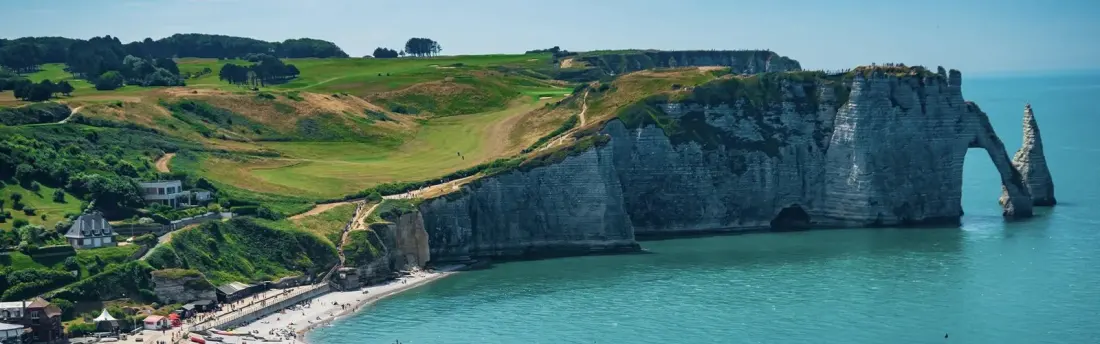
On Normandy's Alabaster Coast, 140km of chalk cliffs drop sheer into the Channel, and the small resort of Étretat sits at the most photographed stretch of them all. A former fishing village with a pebble beach, it's been pulling in the rich and famous since the 1830s — and honestly, the draw hasn't changed much: those arches, that spire, the strange quality of the light.
The cliffs themselves are the headline act. Porte d'Aval is the great natural arch, L'Aiguille (The Needle) is a hollow, 70-metre rock spire rising offshore, and the Manneporte arch completes the set. Monet painted them obsessively — dozens of canvases of glinting flint, soft chalk and sea spray haze. You can walk the same ground via the GR21 cliff-top trail, the old customs officers' path. The south route follows Monet's painting territory; the north passes the Chapel of Notre Dame de la Garde and on to the Jardins d'Étretat. Either way, mind the barriers — erosion is real and the drops are serious.
Those gardens are worth the trip on their own. Les Jardins d'Étretat hold Michelin Green Guide stars for good reason: a surreal clifftop world of sculpted topiary, a whimsical Alice in Wonderland-style maze, and oversized elastomer faces by Spanish sculptor Samuel Salcedo peeking out of the boxwood — all with panoramic views over the sea.
The town wears its history lightly. Composer Jacques Offenbach built Villa Orphée here in 1858 and threw legendary costumed parties that turned Étretat into Europe's fashionable haunt, with a Spanish queen among the regulars; a summer street-operetta festival still honours him. Château des Aygues, built for the inventor of Eau de Melisse tonic, opens in summer with owner-led tours of its park and porcelain collection. Literature fans have two stops: Le Clos Lupin, Maurice Leblanc's house, now a museum with immersive audio tours (his gentleman-thief Arsène Lupin stories made Étretat famous again), and the memory of Guy de Maupassant, who wrote his best work here after Flaubert's death.
Practically speaking: over a million people visit each year, but the place keeps its character. The timber-framed market hall at Place Maréchal Foch anchors the old town, surrounded by boutiques and gourmet food shops, and a street market runs every Thursday morning — ideal for stocking up on cider and cheese.
Getting there is straightforward by French standards: train from Paris Gare Saint-Lazare to Bréauté-Beuzeville, then bus 504 to Étretat, roughly three hours door to door. Come for the cliffs, stay for the gardens and a long lunch — it's one of those rare spots that earns its reputation.