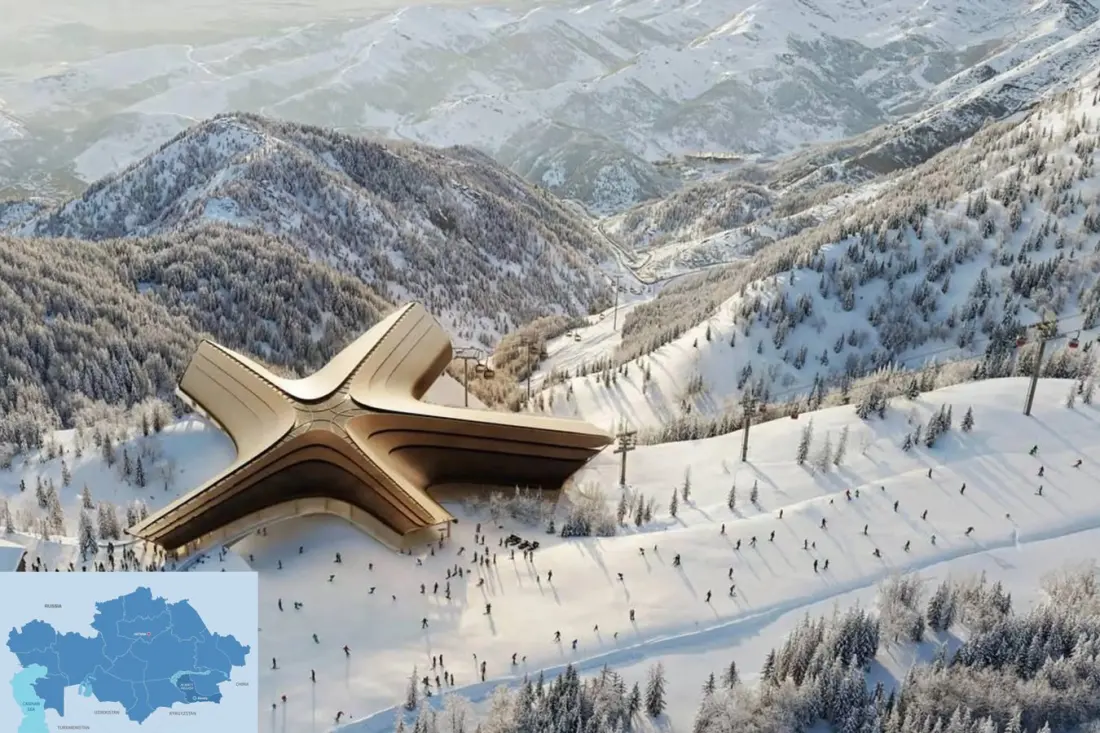
A giant new ski resort is quietly rising above Almaty, and the build is now moving fast. Construction of Almaty SuperSki has entered its active phase, with foundations for the cable car systems already underway, as Kazakhstan's government holds firm to a December 2028 opening date.
At a review chaired by Prime Minister Olzhas Bektenov on November 18, officials confirmed the project is running on schedule. French lift specialist POMA has started work on the cable car foundations and is manufacturing equipment, and in a nice local twist, it has qualified a Kazakh producer to make certain structural components to European standards — meaning the project is also seeding new industrial skills inside the country.
The roster of names behind the resort reads like an architecture awards shortlist. Foster + Partners developed the overall concept, Swiss firm Blumer-Lehmann is handling the timber structures for the base and upper stations, and Denmark's Bjarke Ingels Group won a 24-company competition to design the mountain village, working with Canadian ski-planning veterans Ecosign. Their pitch leans on ski-in/ski-out access, so guests can step from accommodation straight onto the slopes. Earlier appointments include Canada's StructureCraft for timber engineering and US firm Hill International to keep the whole thing on time and on budget.
The scale is genuinely big. Almaty SuperSki will cover 1,022 hectares with 17 lifts, more than 60 kilometres of slopes for all ability levels and a 20-hectare mountain village. It anchors a wider Almaty Mountain Cluster plan that could eventually reach 30 cable cars and roughly 151 kilometres of trails, with capacity for 30,000 visitors a day. The ambition isn't winter-only either: hiking, cycling and mountain biking routes, visitor centres and a mountain safety system are all in the blueprint, positioning the area as a year-round destination.
Kazakhstan has clear reason to invest. Tourism added about US$9.26 billion to the economy in 2025, investment in the sector jumped 32.6% year on year, and the country welcomed 15.7 million foreign visitors. Almaty's mountains already pull in close to half of the country's domestic nature-based tourism, so the cluster is a bet on demand that's already showing up.
There are caveats worth watching. Developers say they're working with ecologists, hydrologists and zoologists to limit pressure on the fragile Ile-Alatau ecosystem, and authorities have floated a registration system for hikers heading into the mountains around Almaty after a string of rescue calls involving poorly prepared walkers. How those balances play out will shape whether the resort earns the reputation it's chasing.
For travellers, this is one to file under 'watch this space'. December 2028 is the target, but Almaty already has a working ski scene — Shymbulak sits right on the city's doorstep — plus a fast-growing food and café culture, so there's plenty of reason to go long before the big resort opens. When SuperSki does arrive, it will put Central Asia firmly on the map as a serious alternative to the crowded and pricey resorts of the Alps.
Reporting by The Astana Times.