South Africa's headline parks and reserves are usually pitched as wildlife or scenery plays. But several of the country's most rewarding destinations layer serious human history on top of the game drives and hiking trails — and in a few cases, the landscape only looks the way it does because people shaped it. Here are five worth building a trip around.
Mapungubwe National Park in Limpopo, where the Limpopo and Shashe rivers meet, protects the remains of a kingdom that flourished between roughly AD 1220 and 1300 and traded as far afield as Arabia and India across the Indian Ocean network. The famous golden rhino, gold sceptre and beads found on Mapungubwe Hill are among southern Africa's most significant archaeological finds, and signs of human presence here stretch back hundreds of thousands of years. Elephants, leopards and strong birdlife share the sandstone cliffs and riverine forest.
The uKhahlamba-Drakensberg Park in KwaZulu-Natal is a World Heritage Site on both natural and cultural grounds. Its basalt peaks and high grasslands shelter endemic and threatened species, but the real draw is rock art: the largest and most concentrated collection of San paintings anywhere in Africa south of the Sahara, tucked into shelters you can reach on foot. Hiking here doubles as a walk through a living archive.
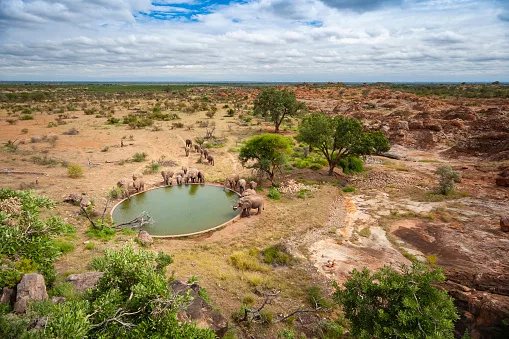
Addo Elephant National Park in the Eastern Cape began in 1931 as a last-ditch effort to save 11 elephants surviving amid hunting and farmland conflict. It has since grown into a vast multi-habitat park — and the Alexandria dune field within it holds ancient coastal middens of shells, bones, pottery and stone tools from communities who lived there long before any park existed.
In the Northern Cape, the Richtersveld flips the script entirely: this mountainous desert of roughly 160,000 hectares is a UNESCO-listed Cultural and Botanical Landscape because of the Nama people's semi-nomadic grazing traditions, which may go back two millennia. Their seasonal movements with livestock, portable rush-mat houses (haru oms) and plant knowledge helped sustain the remarkable succulent Karoo vegetation. History here isn't in a museum — it's ongoing.
Finally, iSimangaliso Wetland Park, also in KwaZulu-Natal, packs coastal forest, dunes, lakes, estuaries and open ocean into one World Heritage Site, with hippos, turtles, rhinos, elephants and clouds of waterbirds. Beneath that are fish traps, shipwrecks, graves and archaeological sites recording thousands of years of settlement — the name itself comes from an isiZulu expression about wonders in the land of the Thonga people.
For travellers, the appeal is obvious: these are places where a single day can hold a rhino sighting and a 700-year-old golden artefact, or a desert hike and a lesson in how herding shaped an ecosystem. They suit anyone who finds wildlife-only itineraries a bit thin — couples, families with curious teenagers, and history buffs who don't want to sacrifice big scenery. Several pair well together on a longer route, though they're spread across the country, so pick one region rather than attempting all five in a week.