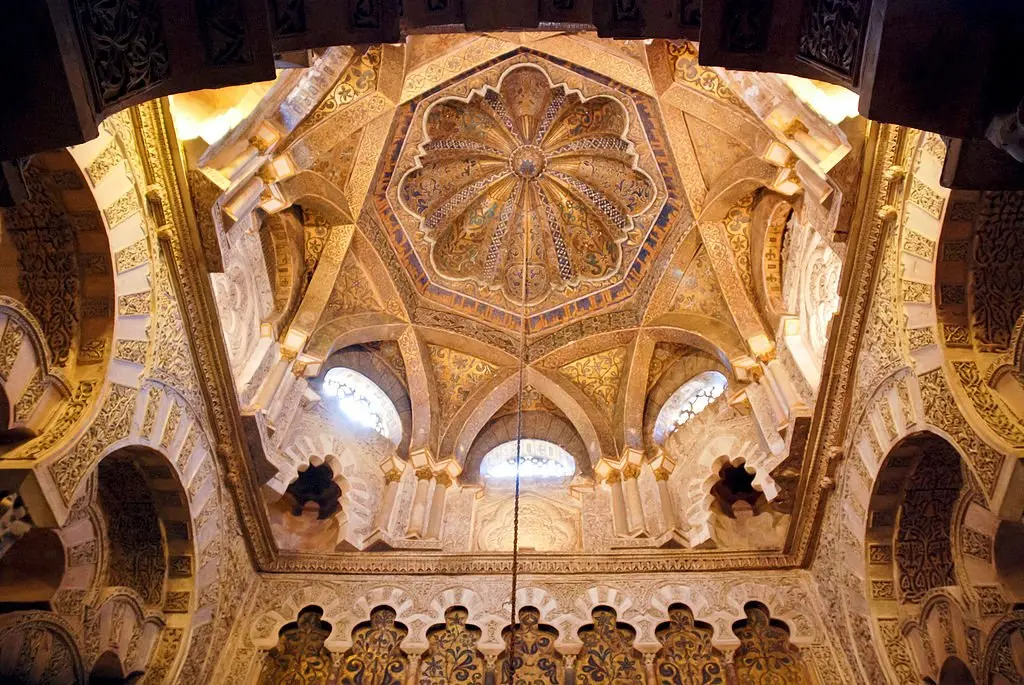
Next time you stand under the pointed arches of Notre-Dame or Canterbury Cathedral, there's a fair chance you're looking at a design idea that started life beside the Nile. Arabist and Oxford scholar Diana Darke traces a line from ninth-century Cairo all the way into the heart of European Gothic — and the story makes a great lens for anyone who likes their sightseeing with a side of detective work.
The key structure is the pointed arch, the signature move of Gothic architecture. One of its early showcases was Cairo's Ibn Tulun Mosque, completed in the ninth century. From there, the theory goes, the form travelled with Amalfi and other Italian merchants through Mediterranean trading ports, eventually turning up in France's great cathedrals and across the Channel in England. Scholars still argue about how direct that route was, but the timing and geography line up neatly.
It wasn't just structure. Fatimid and Mamluk ornament — arabesques, geometric patterns, coloured marble work — drifted into Europe via Sicily, southern France and Spain, carried by goods and travelling craftsmen.
Then came a second, very deliberate wave. In the late nineteenth and early twentieth centuries, European architects who had worked in Egypt started quoting Cairo on purpose. In Vladikavkaz, on the edge of the North Caucasus, the Sunnitskaya Mosque (finished 1906) was designed by Polish architect Józef Płoszko and modelled on Cairo's classical Sunni mosques, especially the Al-Azhar lineage. In Lithuania, the Main Kaunas Mosque of 1933, by Wacław Michniewicz, borrows Mamluk motifs — including from the Funerary Complex of Sultan Qaytbay — in a striking brick building. And Italian architect Antonio Lasciac, who spent decades in Egypt designing Neo-Mamluk landmarks like Bank Misr and Khedivial palaces, brought the style home to Gorizia on the Italian-Slovenian border, where his 1909 villa at Rafut wraps Mamluk revival detailing around a European residence.
Why should a traveller care? Because it changes what you look at. The medieval borrowings are easy to miss — folded into Gothic naves most people never associate with the Islamic world — while the twentieth-century examples are blinking obvious once you know the backstory. If your trips already include Cairo's Islamic quarter, you can now play a rewarding game of spotting its grandchildren in places as far-flung as Lithuania and the Caucasus. It's a reminder that the Mediterranean was never a wall but a conveyor belt of ideas, and that some of Europe's most "European" monuments carry an Egyptian accent.
For the full circuit, pair the obvious stops — Notre-Dame, Canterbury, Cairo's own Ibn Tulun and Qaytbay complex — with the outliers: Kaunas is an easy add-on to a Baltic city break, and Vladikavkaz rewards anyone venturing into the Russian Caucasus.