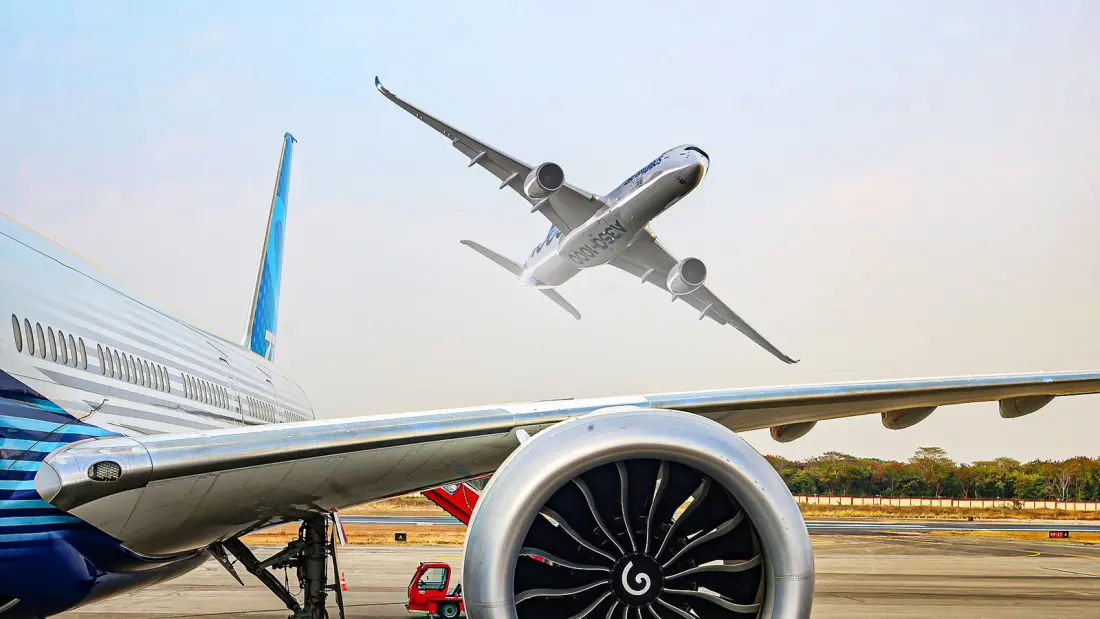
The plane you pick for that next long-haul trip increasingly comes down to two aircraft: Airbus's A350 and Boeing's upcoming 777X. And the real difference between them lives in the engines bolted underneath.
The A350 runs exclusively on Rolls-Royce's Trent XWB — the -84 model on the smaller A350-900 and the more powerful -97 on the A350-1000. Boeing's 777X, meanwhile, will use GE Aerospace's GE9X on both the 777-8 and 777-9. These are not interchangeable options; each engine was built around a different idea of what a modern widebody should do.
Airbus went clean-sheet with the A350, launching the programme in 2006 and building more than 70% of the airframe from advanced materials, over half of it carbon fibre reinforced polymer. That lightness, plus flexing high-aspect-ratio wings and integrated avionics for fuel optimisation, delivered a claimed 25% improvement in fuel burn and CO2 versus previous-generation aircraft when the A350-900 entered service in 2015. The -900 seats 300-350 in three classes and manages 8,600 nautical miles of range; the -1000 stretches to 350-410 seats and 9,100 nautical miles.
Boeing took a different route with the 777X, borrowing heavily from the 787 (flight controls, high-lift design, engine nacelles) and the existing 777 (composite floor beams, tail assembly). Its signature trick is foldable wingtips, letting the extended 71.8-metre wingspan fit standard airport gates. Boeing claims a 20% fuel and emissions cut over the planes it replaces, and says the 777-9 will beat the A350-1000 on cost per seat by 10%.
That points to the core contrast. The GE9X is the most powerful commercial engine ever built — it set a Guinness World Record in 2019 with 134,300 lbf of thrust in testing, though it's rated at a more sensible 110,000 lbf for service. Compare that with 84,000 lbf for the Trent XWB-84 and 97,000 lbf for the -97. At 134 inches, the GE9X's fan is nearly as wide as a 737 fuselage, feeding a 10:1 bypass ratio and a 60:1 overall pressure ratio, all aimed at moving huge amounts of air efficiently under heavier airframes — the 777-8's maximum takeoff weight is 365 tonnes against the A350-1000's 322.
The Trent XWB plays a subtler game. Its three-shaft architecture lets the low, intermediate and high-pressure sections each spin at their own ideal speed, squeezing efficiency from a lighter aircraft built for ultra-long, thinner routes.
So what does this mean for flyers? Right now, it favours Airbus: the A350 has been hauling passengers since 2015, and Rolls-Royce says the Trent XWB has the highest time on wing of any new-generation widebody engine and can fly over a million passengers between removals. The GE9X remains grounded awaiting certification of the 777X, which was originally expected in 2020 and is now hoped for within the coming year. Until then, if you want to fly the newest engine technology in commercial service, it's the A350 you'll actually find on the departure board.